In five days of radio traffic from one underground operation, the trucks held longest in queues were the same trucks reporting overheating hours later. That link matters for mining fleet management, because congestion and overheating are usually handled as separate problems. Congestion gets treated as an efficiency problem, owned by dispatch. Overheating gets treated as a reliability problem, owned by maintenance. The maintenance system logs the thermal fault and the dispatch report logs the long hold, and neither record mentions the other.
On the ground they can be the same problem, and the one place they show up together is on the radio.
Why congestion belongs on the mining fleet management agenda
Queue time is usually tracked because it costs tonnes. What queue time does to the equipment sitting in it, and to the people driving it, deserves the same attention. Three numbers make the case.
- Traffic is where people get hurt. MSHA reports that in 2025, powered haulage accidents accounted for 13 of the nation's 33 mining fatalities (39%) and 426 of 4,792 nonfatal injuries. It runs a dedicated powered haulage safety initiative for exactly that reason. More trucks bunched at one decline means more interactions, more pass calls and more pressure to make up time once the hold clears.
- Weather holds are getting stricter, so trucks will sit longer. In late 2025 a Queensland court backed the regulator's position that when lightning strikes within 16 km, heavy mobile equipment must be parked safely with operators staying in the cab until the storm passes (Australian Mining Review). In Western Australia, WorkSafe reports that 14% of lightning incidents reported to Mines Safety between 2017 and 2025 involved vehicles. Lightning holds are the right call. They also put a whole fleet into an idle queue at once.
- Joined-up condition data pays. Komatsu describes a mine that grouped its 730E haul truck engine breakdowns into six system types, cooling among them. Once targeted fuel-system alerts went live, fuel-system breakdowns fell 38% (Komatsu case study). The lesson travels: failures cluster, and when someone connects the early signals to the right system, the breakdowns drop.
The missing piece is evidence that ties a specific queue to a specific engine.
What 5 days of radio traffic showed
We analyzed five days of radio traffic at one underground operation, March 1 to 5. Two patterns stood out on their own.
- 365+ "holding" calls. "Holding." "Still holding." "Hold at the decline." They concentrated at the same declines and dump points every shift, which makes them a bottleneck map. We cover that in detail in what 365 holding calls reveal about haul road congestion.
- 28 separate overheating reports. Repeated on specific units, clustering under idle and load conditions. Read together, they described a cooling system under growing strain. More on that in the radio warnings hours before a haul truck overheats.
Then we lined the two up. The trucks held longest in queues, at declines, at dump points and during lightning holds, were the same trucks throwing overheating warnings hours later. Congestion wasn't just slowing the operation down. It was cooking the fleet.
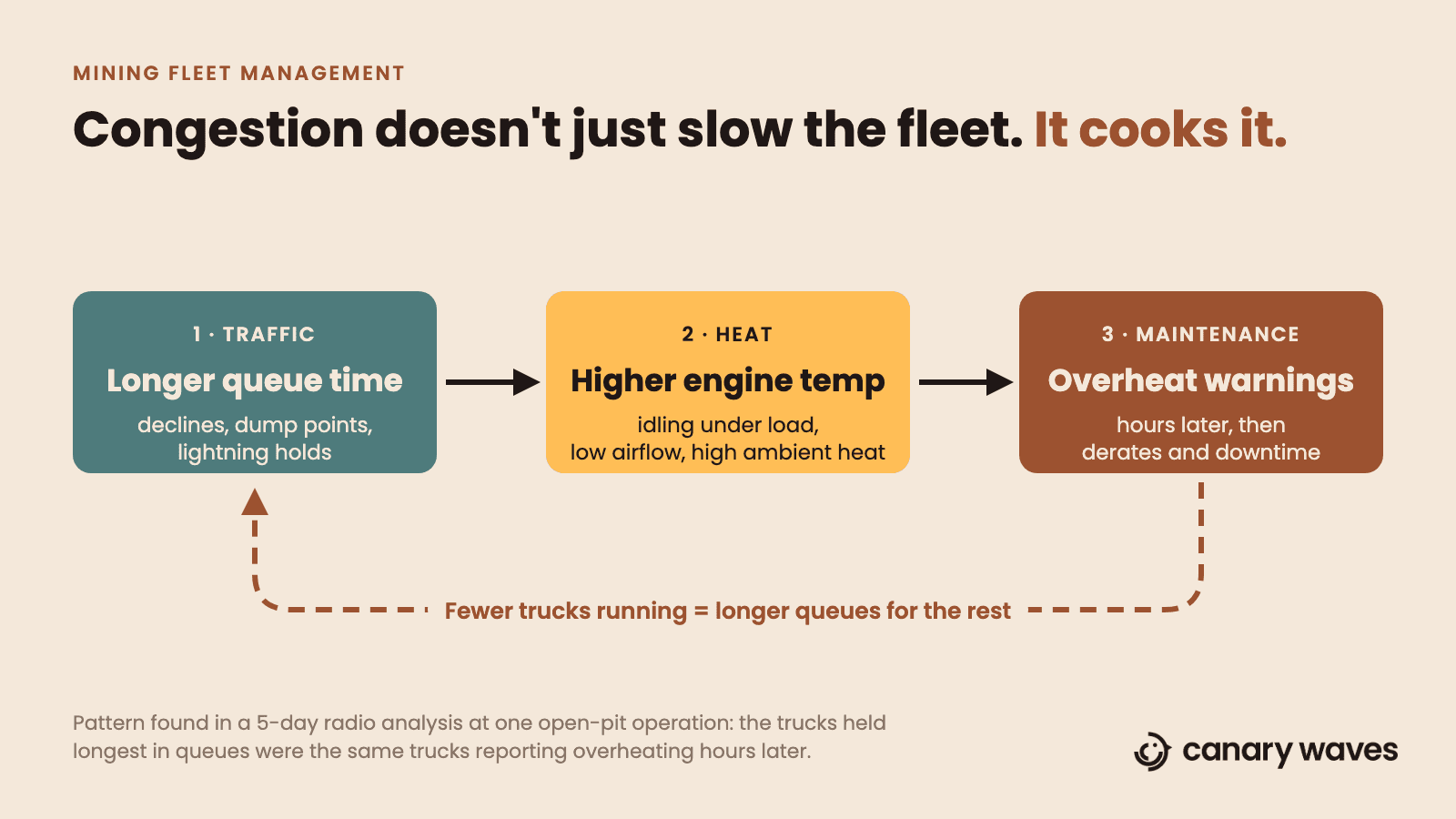
It makes mechanical sense. A truck in a queue may be on a grade, holding on brakes, running the cab air in heat, with little ram air moving through a radiator that may already be carrying dust. Cooling margin shrinks. Repeat that several times a shift and a unit that started the shift marginal has less margin left with every hold.
And it feeds itself. Every truck that parks up with a thermal fault leaves a gap in the circuit. Dispatch reshuffles, the remaining trucks bunch up differently, and the next queue forms somewhere else, with a new set of engines sitting in it. Downtime creates congestion. Congestion creates downtime.
Why no single team can see the link
Maintenance logs and traffic reports sit in separate systems, owned by separate teams. Dispatch sees holds, cycle times and diversions. Maintenance sees fault codes, work orders and parts. Often the only shared key between them is a unit number, and no one compares the two unless someone is given that task.
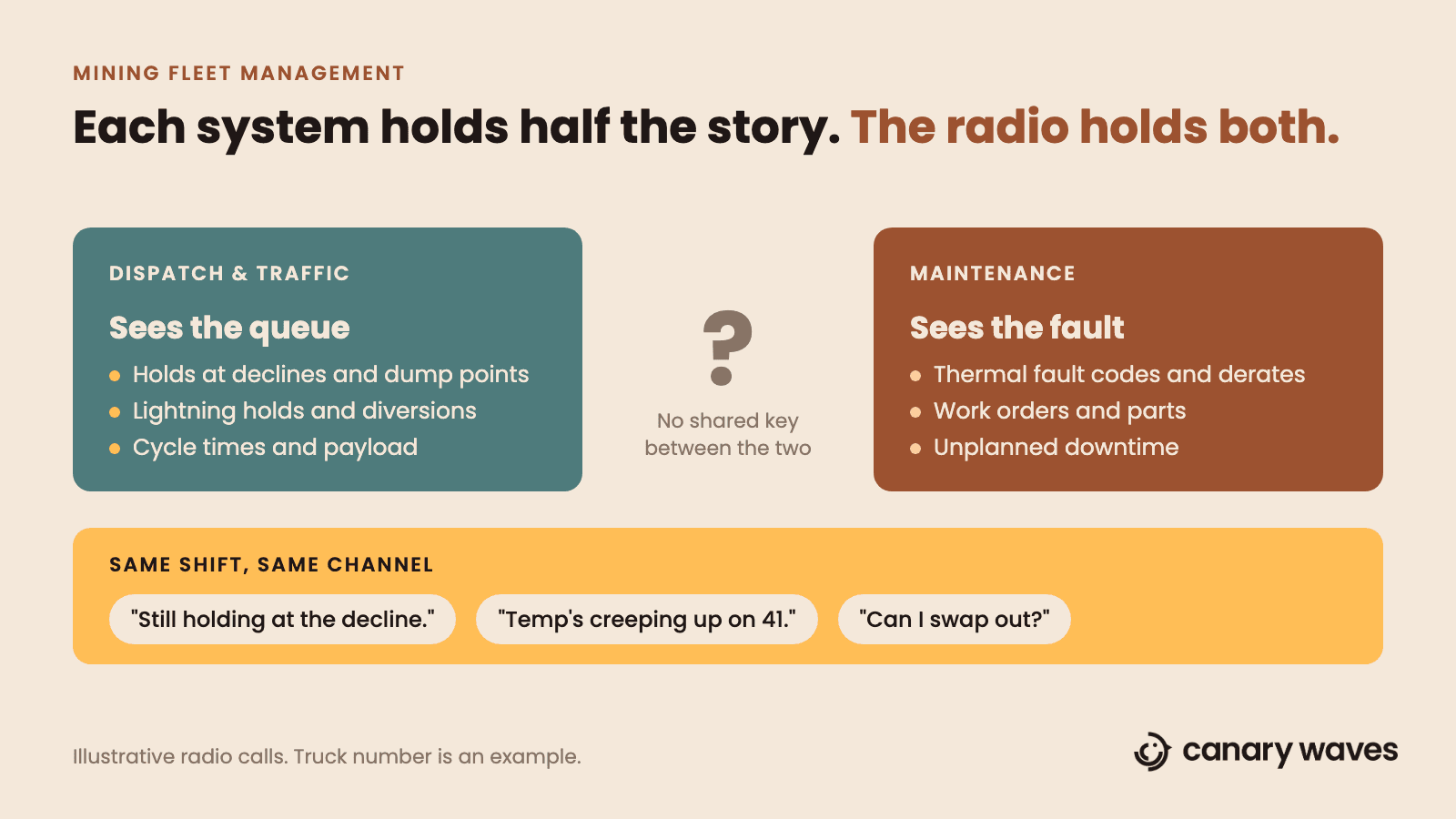
The radio is different. The hold, the temperature comment and the swap-out request all go out on the same channel, in time order, from the same truck. The connection is said out loud. It just goes past at shift speed, to supervisors who cannot listen to every channel at once.
This is not a crew problem. Operators are doing exactly what they should: reporting the hold, flagging the temperature, asking to swap out. The signal is there. The system for hearing it across the whole shift isn't.
Signals to listen for when congestion is cooking the fleet
If you listen back to a shift with this in mind, watch for these signals on the same unit within a few hours of each other:
- Repeated holds at the same decline or dump point, including queue lengths called in by operators.
- Comments that a unit's temperature is creeping up or that it is running warm on a ramp.
- A warning light reported and the unit idled down to cool.
- Requests to swap out of a unit, during the shift or after crib.
- A fleet-wide lightning hold, followed later by a cluster of temperature calls.
One of these on its own is routine. Two or three on the same truck, near the same choke point, is a pattern worth a phone call.
What leaders can do about it, with or without new tools
You don't need a new system to start closing the loop. A handful of simple steps:
- Put queue data and fault data on one sheet, once a week. Pull the top ten units by thermal faults or derates and the top ten by hold time. If the lists overlap, you have your answer, and a reason for dispatch and maintenance to meet.
- Name your choke points. Identify the declines and dump points where holds stack up every shift. Give them names everyone uses on the radio and track them by name. It makes every other step easier.
- Write a long-hold rule with your OEM. Agree what operators should do when a hold passes a set time: park on the flat where possible, follow the manufacturer's idle and cooldown guidance, and call it in if temperature is rising. Make the rule boring and clear so nobody has to make it up mid-shift.
- Treat lightning holds as a heat event, too. After a fleet-wide hold, ask maintenance to watch the units that sat longest. A quick walk-around or a look at temperature trends the same day costs less than a tow off the haul road.
- Make swap-out requests an easy call. If operators feel a swap-out request will cause grief, they may push a hot truck for one more load. Give dispatch a simple script for logging the request and the reason.
- Close the loop in the shift handover. A single line, "units that ran hot and where they were holding", is enough for the next crew and for maintenance planning.
These steps help. Their weak point is that they depend on someone remembering, writing down and comparing what was said on the radio, across every channel, every shift. That is the part most likely to slip when a shift gets busy, which is when it matters most.
Where Canary Waves fits
Canary Waves connects passively to your existing two-way radio, transcribes the traffic with site slang and equipment names, and turns it into shift-level summaries for leaders. Holding calls, temperature mentions and swap-out requests land in one place, by unit, location and time, so the link between a queue and a hot engine shows up while the shift is still running. No new hardware and no change for operators. You can see the kinds of signals we surface on our site.
See the signals we'd surface from a typical shift on your site. Book a 30-minute walkthrough.
FAQ
Can traffic congestion really cause haul trucks to overheat?
It can contribute. Trucks held in queues often sit on grades, in heat and dust, with little airflow through the radiator. In one 5-day radio analysis at an underground operation, the trucks held longest at declines, dump points and lightning holds were the same trucks reporting overheating hours later. OEM and maintenance data can confirm it on your fleet.
Why don't maintenance and dispatch systems show the link?
Because they record different things for different teams. Dispatch logs holds, cycle times and diversions. Maintenance logs fault codes and work orders. They rarely share a common view beyond the unit number, and nobody is tasked with comparing them shift by shift. The radio is one of the few places where both sides of the story are said together.
What is the first step to break the congestion and overheating loop?
Compare two lists once a week: the units with the most hold time and the units with the most thermal faults or derates. If they overlap, bring dispatch and maintenance together around those units and the choke points they queue at. Then set a clear long-hold rule with your OEM so operators know what to do when holds drag on.
How does radio data help mining fleet management?
Radio traffic captures what crews see in real time: holds, hazards, diversions, temperature warnings and swap-out requests. Analyzed across every channel and shift, it shows patterns that sit between systems, like congestion that leads to equipment stress. It needs no new hardware and asks nothing new of operators, because crews already say these things on the radio.
Is this about checking up on operators?
No. The point is to hear the warnings crews are already giving and make sure they reach the people who can act on them. Operators calling holds and temperature lights are doing their job well. The gap is that nobody can listen to every channel at once. Safety intelligence closes that gap without asking crews to do anything differently.