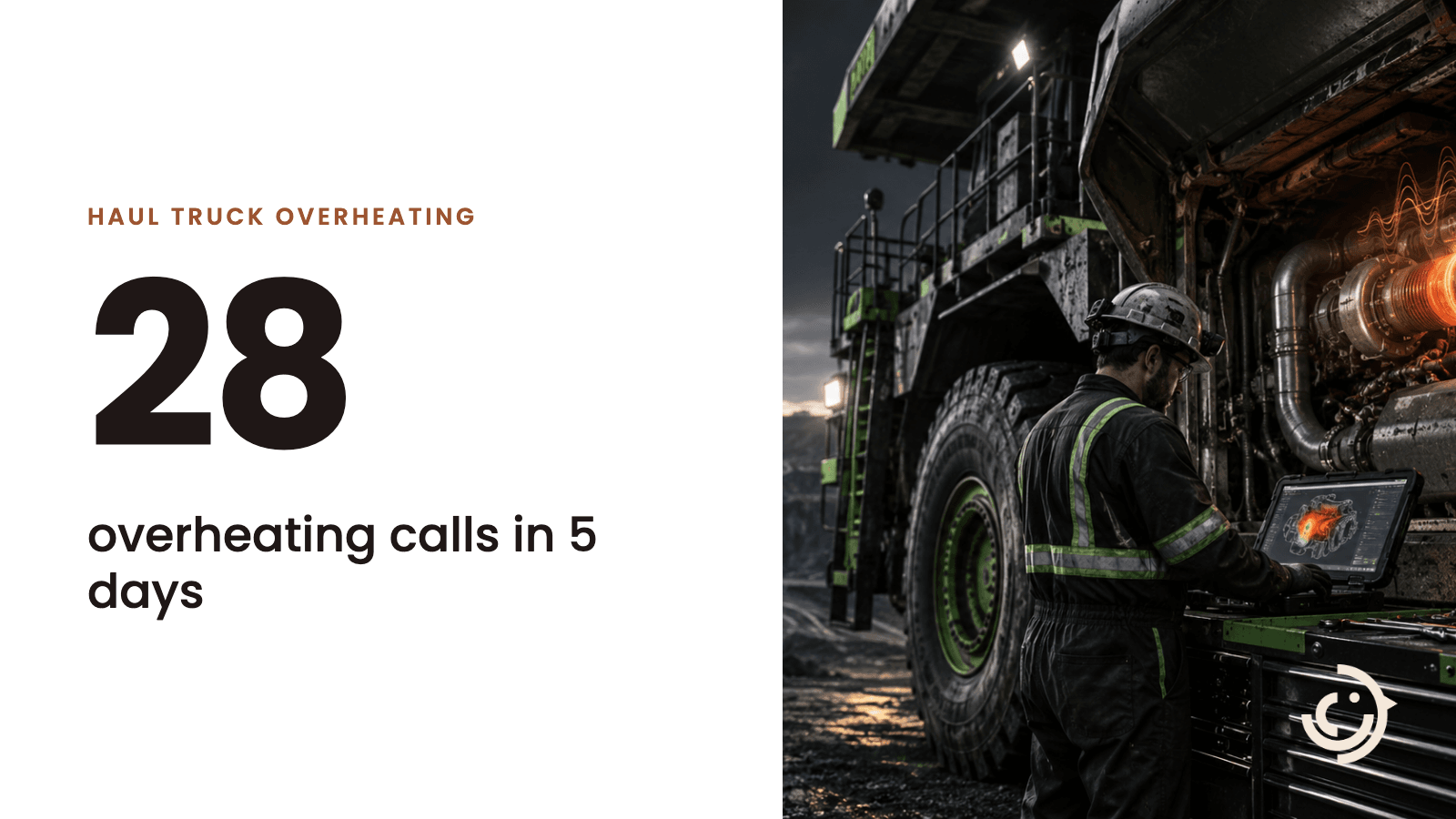
In a 5-day analysis of radio traffic at one underground operation, we surfaced 28 separate overheating reports. That is the case for treating haul truck overheating as something you can hear coming. The warnings were spoken, spread across shifts, and heard by people who were busy doing something else. This post covers what those warnings sound like, why heat is a safety issue as well as a maintenance one, and what leaders can do to act on them earlier.
The radio warnings that come before haul truck overheating
Those 28 overheating reports weren't random. They repeated on specific units, and they clustered under idle and load conditions: trucks sitting in queues, and trucks pulling hard up ramps.
Idle and load sound like opposites, but they stress a cooling system the same way. Under load, the engine makes more heat than usual. At idle in a queue, the truck moves no air through the radiator and the fan may be turning slower. Add summer ambient, dust packed into the cores, or a weak fan clutch, and a unit that copes on a flat haul starts to struggle at both ends of its duty cycle.
Any one of those calls sounds minor. Read together, the 28 mentions formed a single picture: a cooling system under growing strain.
Jack Kellner, our co-founder, worked as a mining engineer at Nevada Gold Mines and Rio Tinto before Canary Waves. This is the pattern that got to him most:
"As a mining engineer, what frustrates me most is when we have the data and knowledge to solve a problem, but still don't move on to it. A truck goes down with a thermal fault, and when you go back through the day, the warning signs had been on the radio for hours. Operators mentioning the temp creeping up. A unit asking to swap out. Nobody connecting it in real time."
Jack Kellner, Canary Waves co-founder and mining engineer
Why it matters: heat is a safety issue, not only a maintenance one
It's tempting to file overheating under reliability and move on. The numbers say otherwise.
- Heat plus fluid equals fire. A NIOSH analysis of U.S. metal/nonmetal mine fires from 1990 to 2001 counted 518 fires. In 89 of them (17%), hydraulic fluid or fuel sprayed onto hot equipment surfaces, causing 46 injuries and 3 deaths. Another 98 (19%) involved flammable liquids or refueling fuel on hot surfaces. Surface operations had the most fires and fire injuries (NIOSH summary via OneMine). A truck running hot all shift is a truck with hotter surfaces all shift.
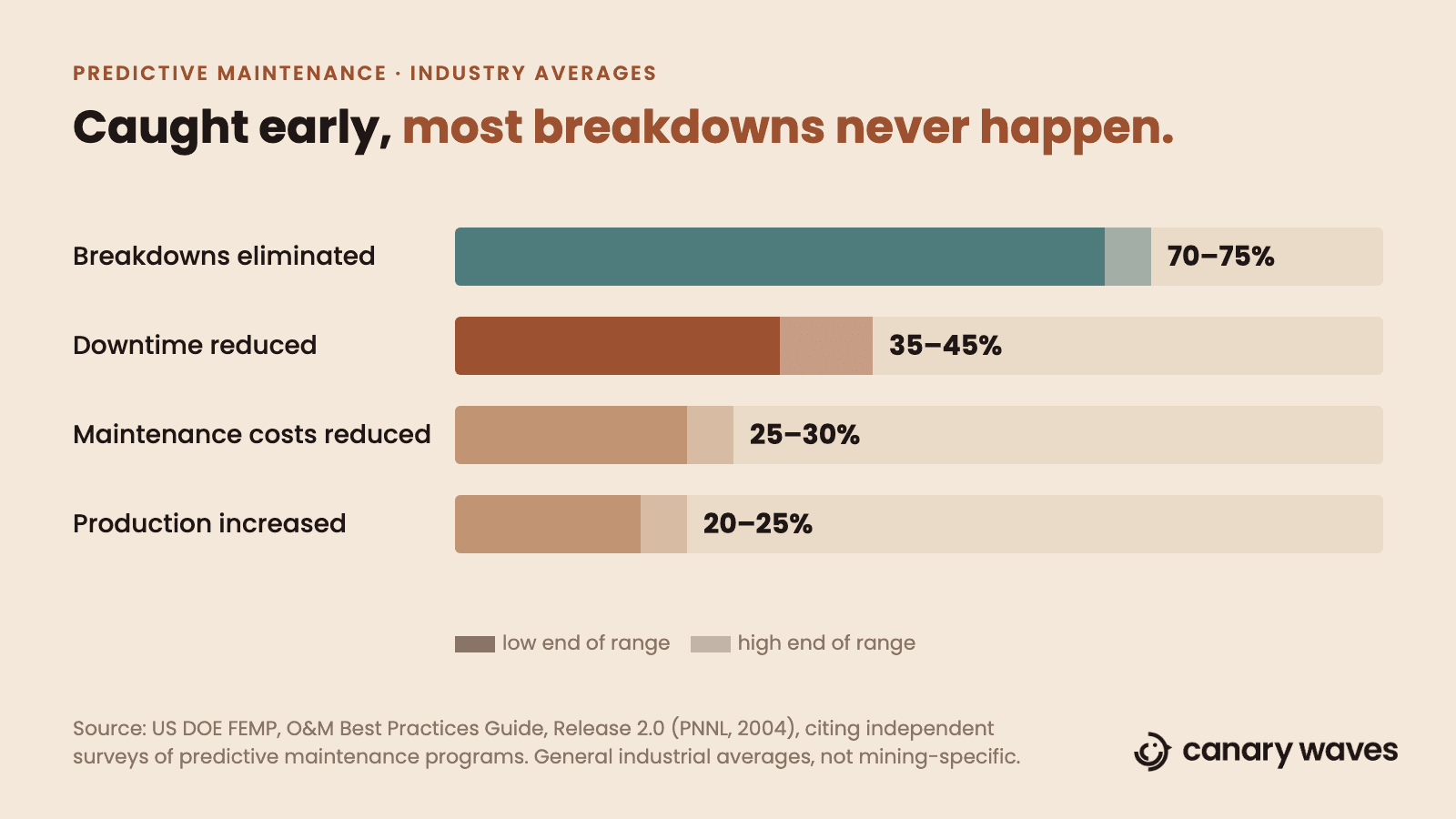
- Early warning prevents most breakdowns. The U.S. Department of Energy's O&M Best Practices Guide (prepared by PNNL) cites independent surveys showing that a working predictive maintenance program eliminates 70% to 75% of breakdowns and cuts downtime by 35% to 45%. These are general industrial averages, not mining figures, but the logic holds: catch degradation early and you fix it on your schedule, not the haul road's.
- Failures cluster by system. Komatsu describes a mine that sorted its 730E haul truck engine breakdowns into six system types, with cooling as one of them. When targeted alerts went live for the fuel system, its breakdowns fell 38% (Komatsu case study). Know which system is under strain, and you know where to look first.
There is also the human side. A truck that dies on a ramp or a single-lane section creates a new hazard for everyone behind it. A mechanic gets sent out to work on a hot engine in traffic. And crews who flag heat and see nothing change have less reason to keep flagging it. Preventable should mean prevented.
Signals to listen for on the radio
Operators report heat in short, plain terms, not as a diagnosis. Signals to listen for:
- Comments that the temperature gauge is sitting high, or that a truck is running warm on a ramp.
- Repeated mentions that the temperature is creeping up on the same unit.
- A warning light reported, followed by the operator idling the truck down or pulling over to let it cool.
- Requests to swap out after a load or after crib.
- Reports of the fan working hard while the engine stays hot, or of losing power on a grade.
Notice what these have in common. They are early, and they are human. An operator can feel a truck laboring on a grade, hear the fan working harder or see the needle sitting higher than yesterday before a sensor crosses its alarm threshold. Telemetry tells you when a limit is breached. The radio can tell you when the trend started.
The tell is repetition. The same signal, from the same unit, more than once in a shift, or the same unit across several shifts. That's the cooling system telling you it is losing the argument with the heat.
What leaders can do about it
None of this needs new hardware. These steps help when they are done consistently.
- Treat heat words as reportable. Make it clear that any report of a truck running warm is a call dispatch writes down, with unit number, location and time. Without a record, the value is lost between hearing it and recording it.
- Use a two-strike rule. A second temperature call on the same unit in the same shift triggers a quick check: radiator core, fan, coolant level, belts, per your OEM's guidance. A ten-minute look beats a tow.
- Make swap-out requests easy and logged. If asking to swap out feels like a fight, operators may push one more load. Log every request and the reason, even if the answer is not yet.
- Listen back after every thermal fault. Pull the radio recording for that unit for the previous shift. Note when the first warning was said out loud. That lead time is the window available to act, and the best argument for acting earlier.
- Check where the hot trucks were holding. Overheating can follow congestion. In our analysis, the trucks held longest in queues were the same trucks throwing warnings hours later. We dig into that in when congestion cooks the fleet.
- Prioritize repeat units in planned maintenance. A unit with several temperature calls in a week should move up the list for core cleaning and cooling system inspection, before summer or the dusty season makes it worse.
The weak spot in all of these is the same: someone has to catch the words as they're said, on every channel, across every shift. On a busy site, that's more than any supervisor or dispatcher can do on top of their actual job.
Where Canary Waves fits
That's why we built Canary Waves to listen across the whole operation at once. It connects passively to your existing radio, transcribes traffic tuned to your site's slang and equipment names, and pulls out temperature mentions, swap-out requests and repeat units into shift-level summaries. No new hardware, no change for operators. See the full set of signals we surface, or read how radio becomes your mine's most underused dataset.
See the signals we'd surface from a typical shift on your site. Book a 30-minute walkthrough.
FAQ
What are the early warning signs of haul truck overheating?
Operators usually notice before the fault code does. Listen for comments that the gauge is sitting high or the temperature is creeping up, warning lights followed by idling down, loss of power on grades, and requests to swap out. The strongest signal is repetition: the same unit mentioning heat more than once in a shift, or across several shifts, especially after long holds or heavy ramp work.
Why do haul trucks overheat in queues?
A truck in a queue often sits on a grade or in heat and dust, with little air moving through the radiator. Cooling margin shrinks, especially on units with dirty cores or worn fans. In one radio analysis, overheating reports clustered under idle and load conditions, and the trucks held longest in queues reported overheating hours later.
How far ahead do radio warnings show up before a thermal fault?
It varies by unit and conditions, but often hours, and sometimes days. In one 5-day analysis, 28 overheating reports repeated on specific units and pointed to a cooling system under growing strain days before it failed. The quickest way to find your own lead time is to listen back through the radio before your next thermal fault.
Is haul truck overheating a safety risk or just a maintenance cost?
Both. Overheating causes unplanned downtime, but hot engines also mean hotter surfaces, and NIOSH found that fluids or fuel meeting hot surfaces were behind about a third of U.S. metal/nonmetal mine fires from 1990 to 2001. A truck that stops on a ramp also creates a new traffic hazard for everyone behind it.
Do we need new sensors to catch overheating earlier?
Not necessarily. Onboard telemetry helps, but your crews already report heat on the radio, often before a fault code fires. Logging those calls, using a two-strike check rule and listening back after every thermal fault will catch a lot. Tools like Canary Waves capture those mentions automatically from the radio you already run, with no new hardware.