Psychological safety in mining is often treated as a culture program. On the radio, it is also a set of leadership habits: the tone, words and follow-up a supervisor, dispatcher or superintendent uses on air, every shift. A reply on an open channel takes a few seconds, and the whole crew hears it. This post is about those habits and what a leader can do with them, starting today.
What psychological safety in mining means on the radio
The term comes from Harvard's Amy Edmondson, who defined team psychological safety as "a shared belief held by members of a team that the team is safe for interpersonal risk taking" in her 1999 study of 51 work teams. She found it was tied to learning behavior: teams that felt safe asked questions, flagged errors and fixed things.
On a mine site, interpersonal risk is concrete. It includes asking for a call to be repeated in front of the whole channel, reporting your own mistake, or asking a basic question when you are new to the site. A two-way radio is one of the few places where a leader's words reach the whole crew at once, so it is one of the most visible places where that shared belief gets built.
This is not separate from physical safety. ICMM's CEO Rohitesh Dhawan put it plainly when the council released its tools for psychological health and safety in July 2025: "Better psychological safety leads to better physical safety."
Why it matters
The clearest mining evidence comes from University of Alberta researcher Lianne Lefsrud and colleagues, who surveyed more than 4,600 workers across five mine sites and over 100 mining and contractor companies. Sites where workers reported more fear had lower hazard reporting rates and higher rates of serious incidents.
What research says about the words we use
Research points to verbal indicators that can signal stress or conflict. These studies come from other settings, not mines, but they apply to a leader's own replies as much as anyone else's.
A 2017 study in the Journal of Applied Psychology by Walker, van Jaarsveld and Skarlicki analyzed transcripts of 434 customer service conversations. Aggressive words, "you"-targeted language (you, your) and interruptions were linked to uncivil responses, while positive emotion words softened that effect.
A 2016 study by Rosen, Koopman, Gabriel and Johnson followed 70 employees, surveyed three times a day for two work weeks. Experiencing incivility reduced self-control, which led to more incivility toward others later the same day. Incivility can spread without anyone intending it. As the Michigan State University researchers put it, fatigued employees "lack the energy to suppress curt and impatient responses."
For a leader on the radio, that gives two practical checks: watch your wording, and watch your own tank.
Six radio habits that build psychological safety on site
None of these need a budget. They sit with supervisors, dispatchers and anyone who talks on channel with authority.
1. Set the tone on routine calls
The climate on a channel is mostly made of ordinary traffic, not big moments. Use call signs and names. Keep your pace even, even when the shift is behind. Give instructions about the task, not the person, and avoid leading with "you" when something has gone wrong. Small courtesies, such as a thank you, cost a second.
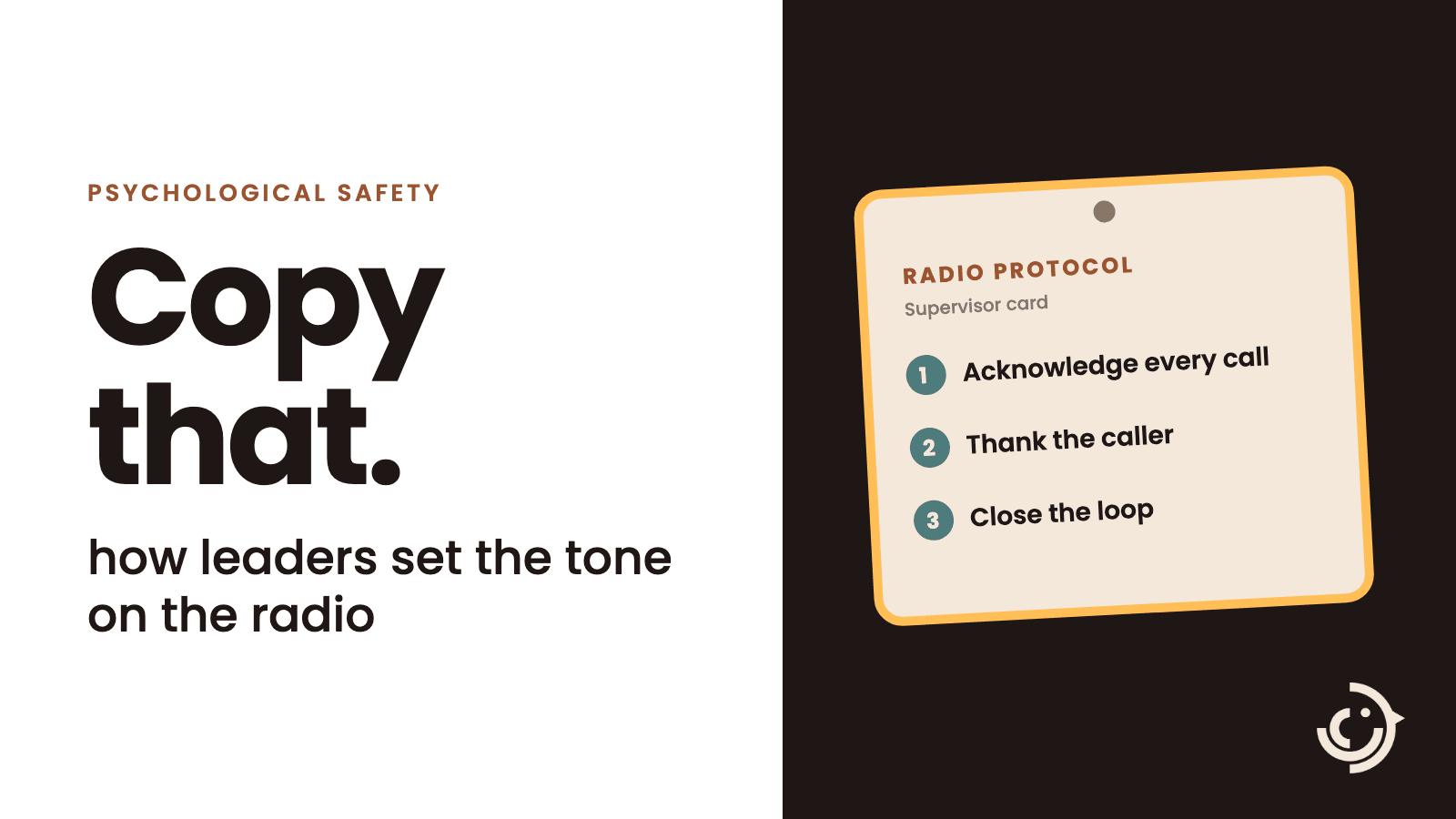
2. Acknowledge every call, even when you can't act
An unanswered call is an answer too. If you are busy, say so, use the caller's call sign and give a time when you will come back to them. Then come back.
3. Treat a reported mistake as information
When someone reports their own error on air, the first questions are about status and location: is everyone OK, where is it, what needs to happen now. Any conversation about what went wrong happens later, off channel, one-to-one, and focuses on the setup rather than the person. The crew hears the first part. Make it the part you would want repeated.
4. Thank people who call things in, specifically
A general thank you is fine. A specific one is better: name the person, name what they spotted and say what will happen next. That tells everyone listening that calling it in was the right move. Lefsrud's advice to leaders points the same way: listen, ask for feedback and explain your decisions.
5. Close the loop where the crew heard it
If a hazard or mistake was raised on channel, close it on channel: say what was done and thank whoever flagged it. Repeat it at the next pre-shift, so the crew can see the report went somewhere.
6. Go first
Leaders make mistakes on air too: a wrong dump assignment, a missed call, a mixed-up truck number. Correct them out loud and plainly: name the error, own it and give the right instruction. Ask questions on air when you are unsure. Asking for a call to be repeated yourself shows the crew it is a normal thing to do.
Check your own channel
Few leaders have heard themselves on the radio the way the crew does. A few practices help:
- Ask a peer to listen for an hour. Not to grade you, just to note how your replies sound when it gets busy.
- Know your load before you key the mic. After a sharp call from above, take a breath before the next reply. If a topic needs more than a quick acknowledgment, thank the caller and say you will follow up in person. The KB&G piece on manager stress has practical ideas for the rest of the shift.
- Use the pre-shift to invite, not just inform. Ask a specific question about what people saw on the last shift, and wait for answers. Good safety shares work the same way.
- Coach radio responses. Supervisors are rarely trained in how to answer a call under pressure. The basics of interpersonal communication skills apply on channel as much as in the office.
Some leaders also find it useful to rehearse harder conversations before they happen. Georgia has a short piece on how building confidence for difficult conversations starts with practice.
Later in this series, we look at the other side of the exchange: how leaders respond when someone raises a concern.
Where Canary Waves fits
No leader can listen to every channel on every shift. Canary Waves connects passively to a site's existing two-way radio and turns radio traffic into team-level, shift-level safety intelligence for leaders. It does not score or identify individuals, and it does not analyze anyone's voice. Working closely with a company's HR and leadership teams, we set up event tracking, agreed with HR and site leadership and reported at team level, that helps identify potential conflict and wellbeing risk. That gives leaders a clearer view of which crews and shifts to visit and listen to in person. It asks nothing new of crews, which matters for how safety technology gets adopted on the frontline.
Want to see how this would work across your crews? Book a Canary Waves walkthrough.
FAQ
What is psychological safety in mining?
It is a crew's shared belief that it is safe to speak up: to call a hazard, ask a question, report a mistake or challenge a decision. Amy Edmondson defined team psychological safety in her 1999 study of work teams. On a mine site, it shows up in what people are willing to say on the radio.
How does a leader's radio talk affect psychological safety?
The radio is public, so every reply a leader gives is heard by the whole crew. Calm tone, call signs, quick acknowledgment and specific thanks are part of what the crew experiences each shift. Research in other settings links aggressive wording and interruptions to uncivil replies, and positive words to softer ones.
How should a supervisor respond when someone reports a mistake on the radio?
Thank them for calling it, then ask about status and location: is everyone OK, where is it, what needs to happen now. Keep any discussion of what went wrong off channel and one-to-one, focused on the setup. Later, close the loop on the same channel so the crew hears the outcome.
What can leaders do this week to improve the climate on their channel?
Pick one habit and practice it every shift. Acknowledge every call with a time if you can't act right away. Thank callers by name and say what they spotted. Correct your own mistakes on air. Ask a peer to listen to your channel for an hour and tell you how you sound.
Is analyzing radio traffic for psychological safety a form of surveillance?
It should not be. Canary Waves works at team and shift level and never scores or identifies individuals. Any event tracking is agreed with HR and site leadership and reported at team level. The aim is to help leaders decide where to show up and listen in person, not to catch anyone out.