Mining safety technology adoption is decided on the frontline, not in procurement. A tool that works in the demo still has to fit into a twelve-hour shift, and the question that decides its future is simple: what does it ask of the people who have to use it?
The two-way radio is the benchmark. It asks almost nothing, and it never stops working.
Why mining safety technology adoption stalls on the frontline
Think of the tools that ask the most of operators: wearables to track fatigue, collision-avoidance units that alarm when a light vehicle parks nearby, and hazard-reporting apps that need a login, a signal and two free hands. Each can be a good idea, bought with good intentions. Each also adds a step to someone's shift.
The numbers outside mining say the same thing. McKinsey has reported that 70% of transformation programs fail, and 72% of companies with failed programs name employee resistance or management behavior as the main barrier. In energy and natural resources, which includes mining, Bain found that 75% of companies say their digital initiatives fail to scale as anticipated, and only 25% get beyond pilots to broader adoption.
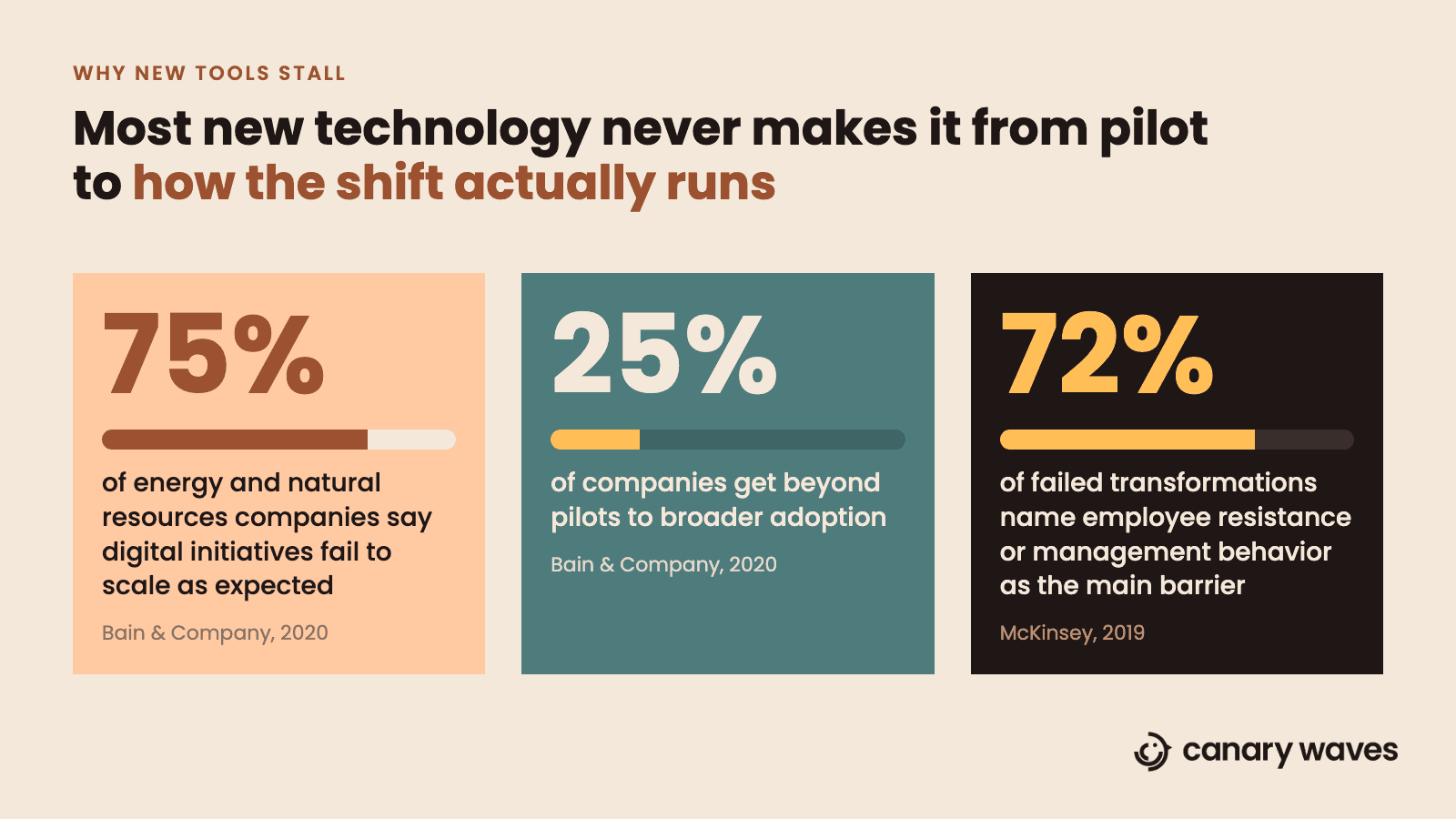
Those are broad, cross-industry figures, and they measure big programs rather than a single safety device. But the pattern holds at every scale. The technology usually works in the demo. What fails is the part where it has to fit into a twelve-hour shift, run by people who already have plenty to do, in dust, heat, rain and the dark.
Mining has its own evidence, and it's more specific. When NIOSH researchers interviewed mineworkers at seven mines that had installed proximity detection systems on mobile haulage equipment, workers said the systems affected loading, tramming, section setup and maintenance, and described increased burden, exposure and risk. That's a safety system, designed to protect people from being pinned or struck, that the people using it felt made parts of the job harder and, in some cases, riskier.
That's not a story about bad workers or bad technology. Proximity detection saves lives. It's a story about what happens when a tool lands on a crew without fitting the work they actually do. The tool asks for something. The shift doesn't have it to give. Something gives instead.
Regulators have noticed. MSHA's 2023 final rule on surface mobile equipment requires written safety programs that include input from miners and their representatives. Input from the people doing the work is now part of the requirement, not a nice-to-have.
Signals that a safety tool is fading
Adoption problems can show up on the radio before they show up in a usage report. Listen for:
- Tasks moving back onto the radio. The workaround that becomes the process. If the radio is the fallback, the radio is the real system.
- Alerts dismissed as routine. Alarm fatigue. Once a crew learns to tune out an alert, it stops protecting anyone.
- Reports deferred to end of shift. The report that gets batched, then shortened, then skipped.
- Questions about charging or finding the device. Anything that needs charging, carrying or remembering will eventually be flat, left behind or forgotten.
- Uncertainty about whether the system is on. If nobody's sure the system is working, nobody trusts it.
None of these are complaints anyone would put in a survey. They're just what people say to each other while getting the job done. That's exactly why they're worth hearing.
What survives on the frontline
Look around any site and ask which safety practices have lasted twenty years or more. The list is short and telling: the pre-start check, the toolbox talk, the berm, the pass call, and the two-way radio. None of them are clever. All of them fit inside work people were already doing.
The radio is the purest example. Nobody had to be convinced to use it. Nobody forgets to charge it, because it's built into the truck. Nobody needs a login. Operators use it throughout the shift because the job doesn't work without it. Dozers, haul trucks, graders, shovels and dispatch all coordinate through it: that's the real operating system of a mine, and it runs on voice.
That points to a simple test for any new safety tool. Does it sit on top of something crews already do, or does it ask them to do something new? The first kind tends to survive. The second kind needs a very good reason, a lot of support and an honest plan for week six.
What good sites do to make safety technology stick
Getting adoption right isn't luck, and it doesn't take more patient crews. A few simple rules help.
- Bring operators in before the purchase order. Ask the people who will live with the tool what it will get in the way of. MSHA's surface mobile equipment rule already expects miner input in the safety program. Extend that habit to the tools that support it.
- Count what the tool asks. New hardware in the cab. A login. A screen mid-shift. A new alarm to respond to. A report to remember. Every one of those is a step someone can skip on a bad night. Fewer asks, better odds.
- Pilot on the worst shift, not the best. A trial on day shift with the keenest crew and a vendor rep on site proves almost nothing. Run it on nights, in the wet, with the crew that's short a person.
- Kill nuisance alarms fast. Every false alert trains people to ignore the real one. If an alarm fires more than people think it should, fix the thresholds before you defend them.
- Measure at week six, not week one. First-week usage says little. The real number is what's still happening after the novelty wears off and the vendor has gone home.
- Start from what crews already do. Before adding a new channel for information, look at the ones already carrying it. Pre-starts, hazards, holds and equipment complaints are already being spoken out loud every shift.
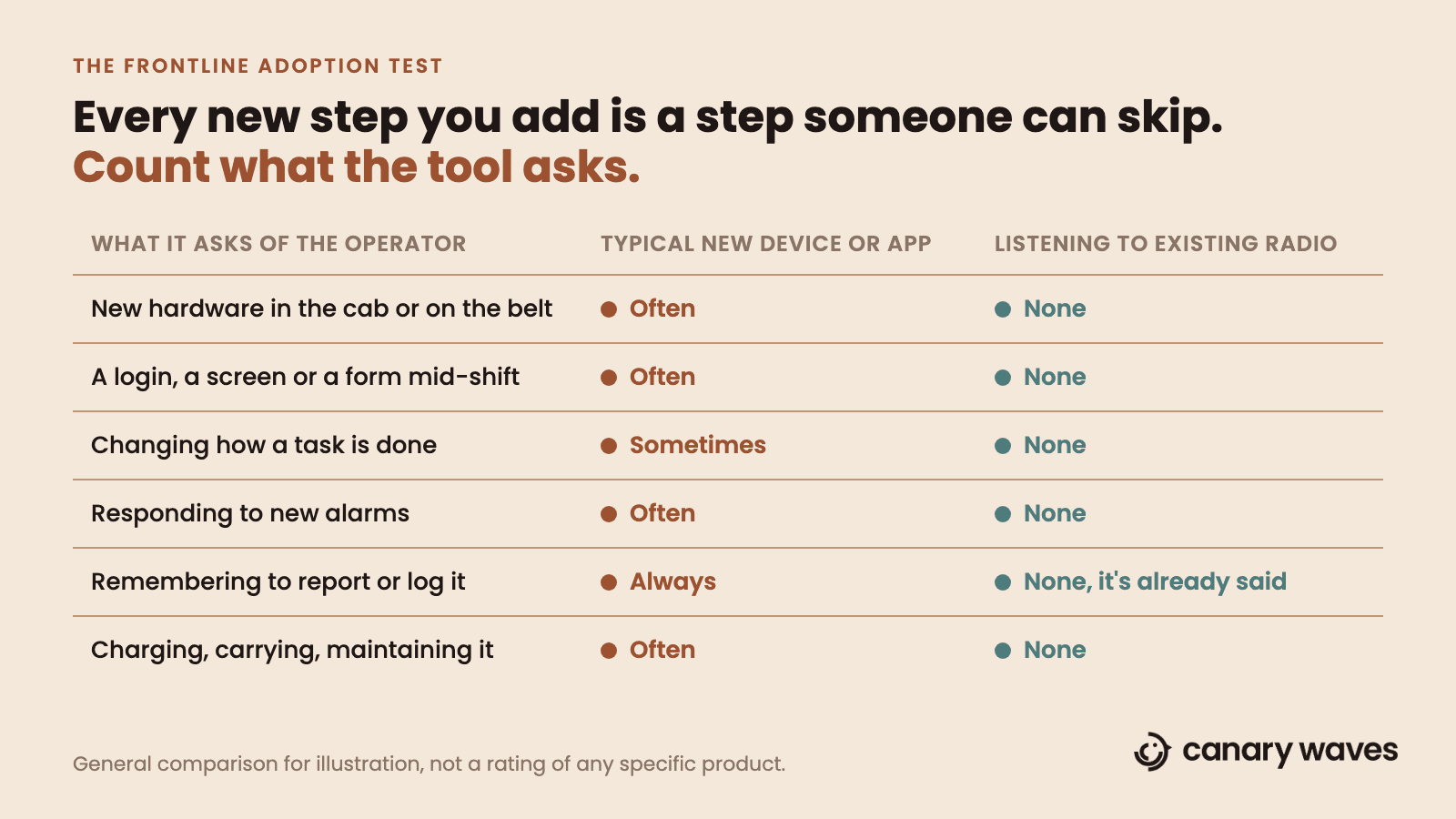
That last rule is the one most often missed. Sites spend real money building new ways to collect information that is already crossing the radio, every shift, for free. Hazard calls. Holding calls. Overheating complaints. Near-miss language. We've written about what that looks like in your mine's most underused dataset and in why near-miss language spikes with congestion.
Where Canary Waves fits
We built Canary Waves around the adoption problem on purpose. It connects passively to the two-way radio a site already runs. No new hardware in the cab, no new app, no new habit for operators to remember, resent and abandon three weeks in. Crews keep talking exactly as they do today. The intelligence goes to leadership as shift-level summaries: holds by location, hazard mentions, equipment warnings and near-miss patterns. You can see the signals we surface.
The operations pulling ahead aren't working harder. They're hearing more.
See the signals we'd surface from a typical shift on your site. Book a 30-minute walkthrough.
FAQ
Why does mining safety technology adoption fail so often?
Most tools fail on the frontline, not in procurement. They ask operators to carry, charge, log in, respond to alarms or change how they work, during shifts that already have no slack. NIOSH interviews about proximity detection found mineworkers described added burden and risk. When a tool costs more than it gives back, crews work around it.
How can mine sites improve technology adoption among operators?
Involve operators before buying, not after. Count every new step the tool adds and cut as many as possible. Pilot on the hardest shift, fix nuisance alarms quickly, and judge success by usage after six weeks rather than one. Where possible, build on things crews already do every shift, like radio calls.
What is alarm fatigue in mining?
Alarm fatigue happens when operators hear so many alerts, especially false or low-value ones, that they start to tune them out. On mobile equipment it can happen with proximity and collision-avoidance systems tuned too sensitively. The danger is that a real warning gets the same shrug as the hundred false ones before it.
Do safety tools have to add work for operators?
No. Some of the most durable approaches use information crews already produce. Two-way radio is a good example: operators already call hazards, holds, equipment problems and near misses out loud every shift. Listening to that traffic and turning it into safety intelligence for leaders asks nothing new of the people doing the work.
How do you measure whether a safety tool has really been adopted?
Look past the launch numbers. Check how many shifts and crews are still using it six weeks in, on nights and weekends as well as day shift. Listen to the radio for workarounds, such as tasks being called in instead of entered in the tool. If the old way is quietly back, the tool hasn't been adopted, whatever the dashboard says.