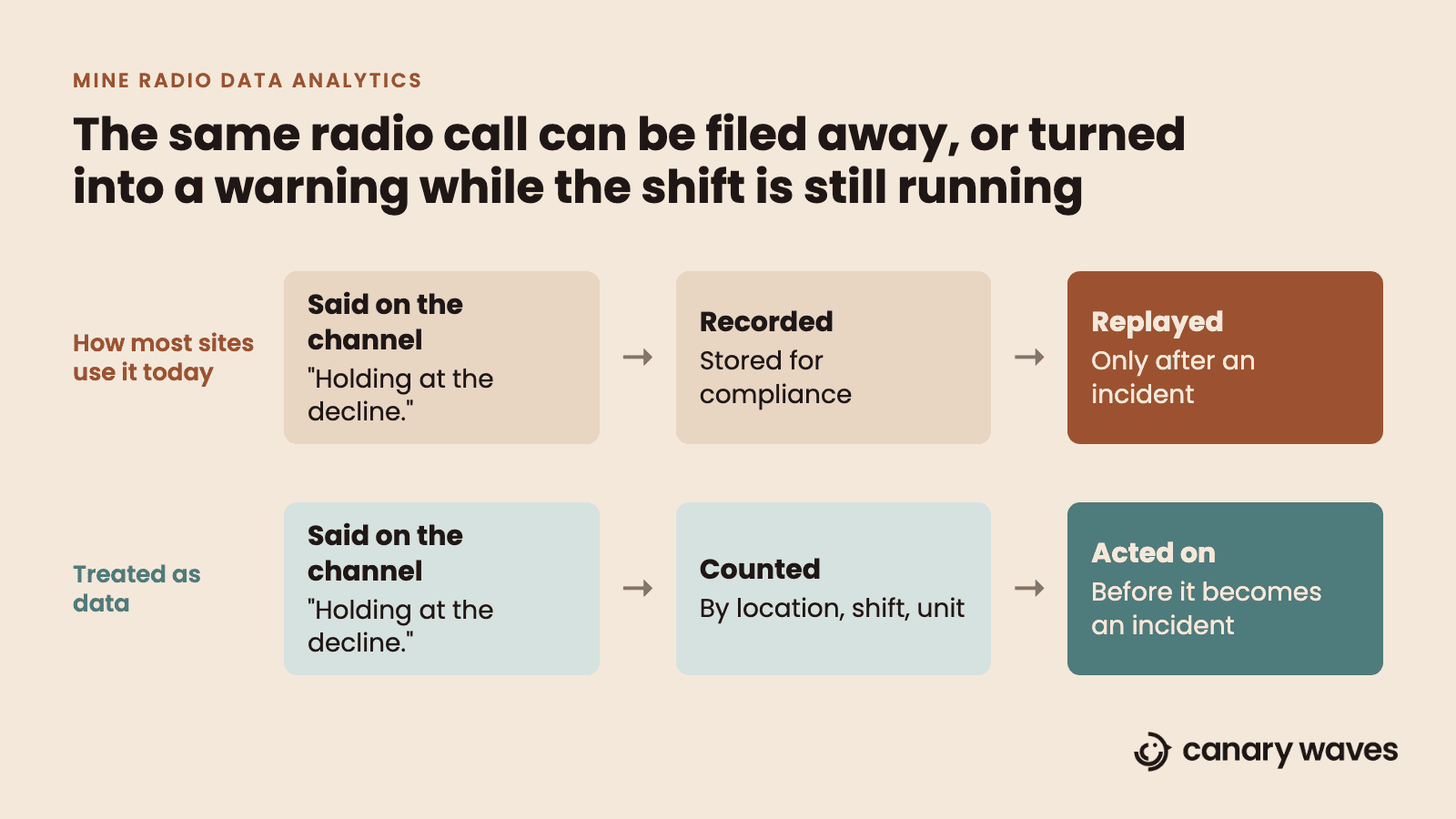
Mine radio data analytics treats two-way radio traffic as what it is: a running, spoken record of how work actually happens on site. Holds at the decline. A rock on the ramp. A unit running hot. A bypass closed. Crews report all of it on the radio, and once the call ends, the information is gone unless someone wrote it down.
Most of that traffic is recorded for compliance and replayed only after something goes wrong, or never kept at all. This post sets out why that matters, what five days of radio traffic from one underground operation contained, and what leaders can do with their own radio channel, with or without new tools.
Why mine radio data analytics matters now
Three numbers explain why the radio deserves a second look.
- Vehicles are still where people get killed. Powered haulage was the leading cause of US mining deaths in 2025, accounting for 13 of 33 fatalities in MSHA's preliminary count, as reported by Pit & Quarry. Haul trucks, light vehicles and loaders are exactly the equipment that coordinates by radio all shift.
- Near misses are frequent, and many are serious. When NIOSH researchers reviewed one aggregates company's near-miss reports over a single summer quarter, workers had logged 249 near misses. Of the 167 confirmed as work-related, 56% were rated high or critical risk (Haas, Demich and McGuire, NIOSH, 2020). That is what gets written down when a site makes reporting a habit. Anything said on the radio and never written down is not in that count.
- Most organizations do not use most of their data. In a survey of more than 1,300 business and IT leaders, Splunk found that 55% of an organization's data is "dark", meaning it is unknown or never analyzed. Radio traffic is unstructured, spoken, and spread across channels nobody can monitor all at once.
Put those together and the gap is obvious. The highest-risk activity on site is coordinated by voice, the warning signs are frequent, and the voice record is the least-used dataset in the operation.
What the radio actually carries
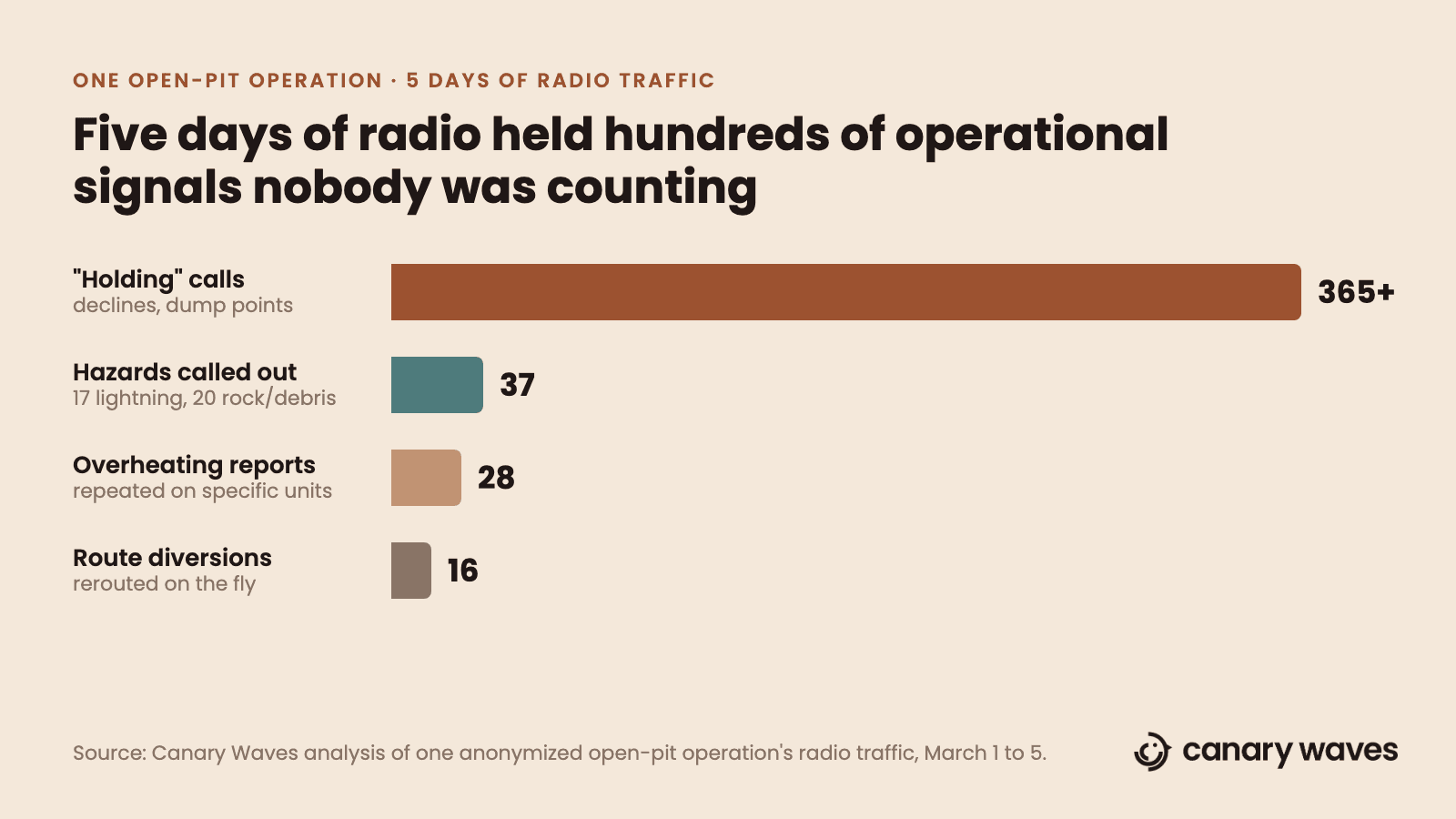
Radio traffic is not just instructions. It also carries status reports, hazard calls and equipment complaints. When we analyzed five days of traffic (March 1 to 5) from one underground operation, it contained:
- 365+ "holding" commands. "Holding." "Still holding." "Hold at the decline." Same declines, same dump points, every shift. Read together, they are a bottleneck map.
- 28 separate overheating reports, repeated on specific units and clustering under idle and load conditions.
- 37 safety hazards called out over the air: 17 lightning alerts and 20 rock and debris obstructions.
- 16 route diversions in five days, from bypass closures and blocked declines, rerouted on the fly with no record.
The most useful finding was a link between two of those. The trucks held longest in queues were the same trucks throwing overheating warnings hours later. Congestion was cooking the fleet. Maintenance logs and traffic reports sit in separate systems owned by separate teams, so that link does not show up in either one. We wrote that one up in detail in When Congestion Cooks the Fleet.
None of this was hidden. Crews said it on the open channel. The gap is not in what crews report. It is in how the reports are captured and added up.
Signals to listen for
A single call is usually routine. These are the patterns worth tracking:
- Repeated holds at the same location. One hold is routine. Several holds from the same unit at the same decline, shift after shift, point to a bottleneck.
- Repeated temperature comments on the same unit. Mentions of a unit running warm, repeated across a shift, are a maintenance signal worth logging before a thermal fault code appears.
- Hazard calls with no closing call. A hazard reported once and never followed by a cleared or logged response may still be there for the next truck.
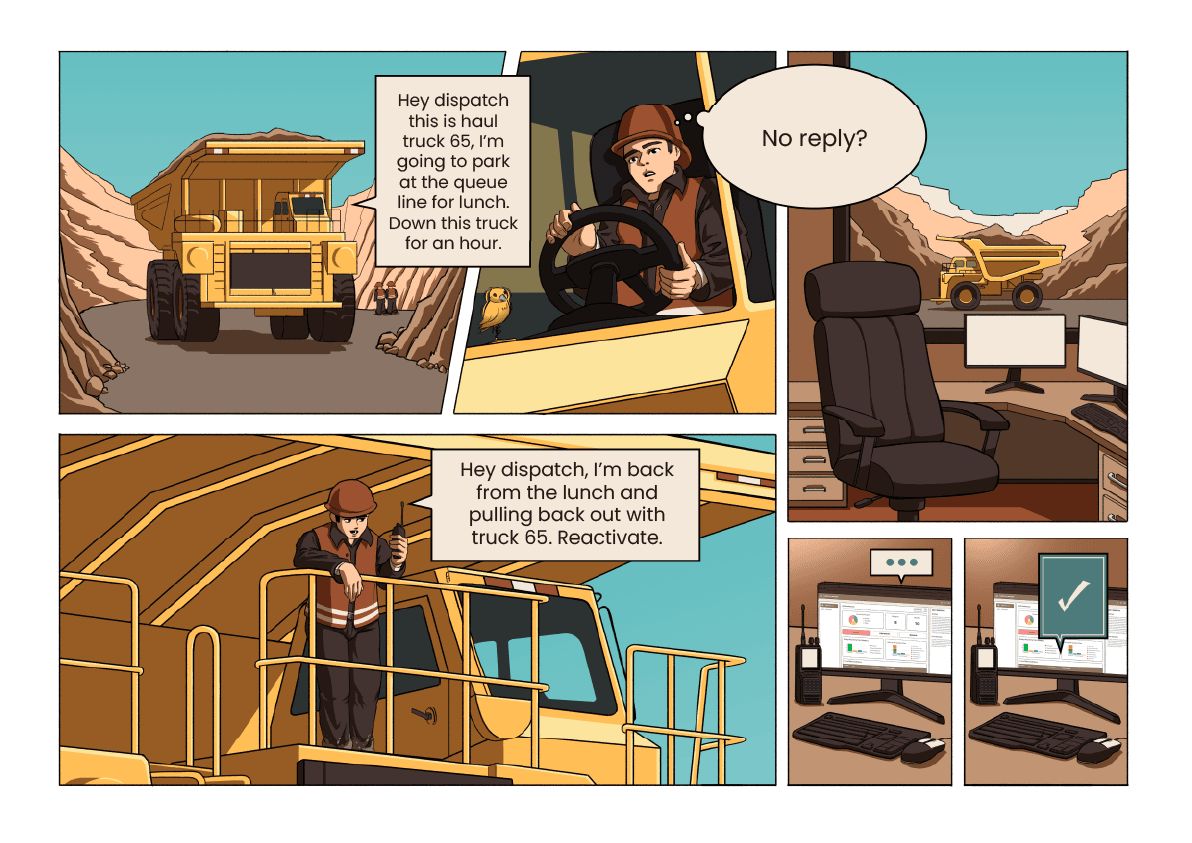
- Unanswered calls to dispatch. Repeated calls with no response show that the channel or the dispatcher is overloaded, which is when instructions get missed.
- Unplanned diversions. Every reroute changes who is where, and the rest of the fleet only knows if they heard that one call.
None of these signals is alarming on its own. What matters is the repetition, the location and the timing. That is what a person on a busy channel cannot track and what a structured record can.
What leaders can do with radio traffic, starting tomorrow
You do not need new technology to start treating the radio as a safety and operations dataset. A few simple steps:
- Listen back on purpose, not just after incidents. Pick one shift a week and have a supervisor or dispatch lead replay an hour of a busy channel. Note every hold, hazard call and equipment complaint.
- Tally the repeat words. A tick sheet for "holding," "warm" or "hot," "rock," and "diverting," broken down by location, can show you your bottlenecks and problem units.
- Close the loop on hazard calls. Agree that every hazard called on the radio gets an explicit "cleared" or "logged" response from dispatch. If there is no closing call, it is still open. Our post on hazard identification in mining covers how to make that stick.
- Put maintenance and traffic in the same room. A 10-minute weekly look at which units are queuing longest and which units are running hot will surface links that neither team sees alone.
- Bring it into the pre-shift meeting. Share one thing the radio told you last week. It shows crews that what they report is heard.
- Treat it as safety intelligence, not monitoring. The point is to catch the system's weak spots, not to score individual operators. If crews think the radio is being used against them, they may stop saying the useful things.
The newer MSHA rule on written safety programs for surface mobile equipment asks operators to identify hazards and risks with miner input. Your radio channel is a running log of exactly that input, if you capture it.
Where Canary Waves fits
Canary Waves does the listening at scale. It connects passively to your existing two-way radio, transcribes traffic with models tuned to site slang and equipment names, and turns it into shift-level summaries for leaders: holds by location, hazard calls and whether they were closed, equipment stress by unit, and the patterns that link them. No new hardware, no new app, nothing changes for operators. See the kinds of signals we surface, or the full five-day picture from the operation above.
Preventable should mean prevented. In the five days above, the warnings were already on the radio.
See the signals we'd surface from a typical shift on your site. Book a 30-minute walkthrough.
FAQ
What is mine radio data analytics?
Mine radio data analytics turns two-way radio traffic between operators, dispatch and supervisors into structured information. Calls are transcribed, tagged by type, location, unit and shift, then summarized so leaders can see patterns such as repeated holds, hazard mentions, equipment complaints and route changes that would otherwise disappear once the call ends.
Does analyzing radio traffic mean monitoring individual operators?
It should not. The value is in system-level patterns: which declines queue every shift, which units keep running hot, which hazards never get a closing call. Used well, it is safety intelligence that helps leaders fix bottlenecks and equipment issues, not a tool for scoring or disciplining the people doing the work.
What kinds of safety signals show up on mine radio?
Common signals include repeated "holding" calls at the same locations, rock and debris on haul roads, lightning alerts, equipment overheating or warning lights, route diversions and unanswered calls to dispatch. Near-miss language and sharp exchanges also tend to cluster around peak congestion, which makes timing as important as content.
Do we need new radios or hardware to analyze radio data?
No. Most sites already record or can tap their existing two-way radio system. Canary Waves connects passively to that infrastructure, so there are no new devices for operators, no new app and no change to how crews talk. A proof of concept can typically start within weeks rather than months.
How is this different from reviewing recordings after an incident?
Post-incident review looks at one event, after the damage is done. Radio data analytics looks across every channel and shift continuously, so repeated warnings are visible while they are still warnings. The goal is to act on a pattern of overheating calls before the thermal fault, not to reconstruct it afterward.