Canary Waves did not start in a lab or a pitch competition. It started in an incident investigation at a gold mine in Nevada, with a mining engineer listening to an MP3 file of radio chatter and asking a slightly awkward question. This is the Canary Waves founder story: how Jack Kellner got the idea, why it nearly stalled, and how Julia Georgi turned it into a real product.
Most of it comes from Jack's conversation on episode 53 of the Mine EX-Plorers podcast. If you want the tailings and Regeneration side of that episode, KB&G wrote it up in Mine EX-Plorers EP53: Waste From Mining to Intelligence.
A city kid who stumbled into geology
Jack is from Chicago. "I'm a city boy," as he puts it. He went to the University of St. Thomas in Minnesota, played college football, and planned on biology, maybe medicine like his brother.
Then the January-term trip to Costa Rica filled up before he could sign up. The next best option was Geology of the Southwest United States, a field trip through Nevada. He took it as a consolation prize and came home hooked. He went back to that field camp several times, graduated in environmental geology, and met his wife there. She is a geologist too.
What followed is a career most mining people will recognize, because it zigzags:
- Environmental consulting. Drilling, site investigations, months on the road.
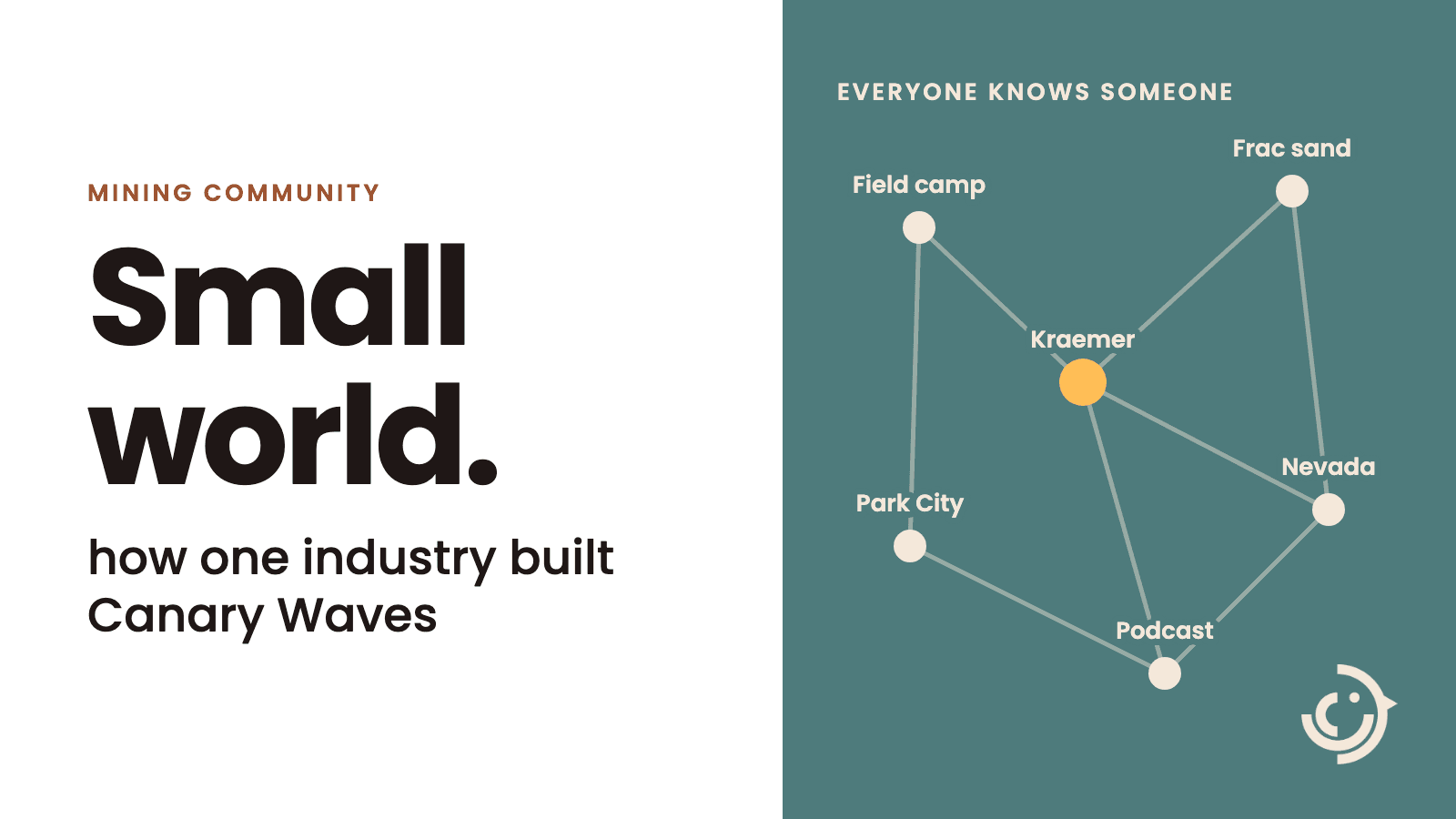
- Aggregates and frac sand. Compliance and exploration at Kraemer Mining & Materials, a crushed limestone producer that also contract-operated frac sand mines through the boom years.
- Nevada Gold Mines. One of the first employees of the new joint venture. Four years commuting from a trailer, moving from environmental compliance into capital projects, and a master's in mining engineering from South Dakota School of Mines along the way.
- Rio Tinto and Regeneration. Large capital projects, then mine waste and tailings reprocessing.
That mix of field geology, operations and project economics turned out to matter. It is the reason Canary Waves talks like a mine site and not like a software vendor.
The incident review that started Canary Waves
The idea came at Long Canyon, a Nevada gold mine Jack remembers as a genuinely safe, well-run operation. One of its rare injuries happened when a pressure washer wand kicked back and hurt a worker's eye. The investigation later found calibration problems with the tank, which had been overheating and over-pressurizing.
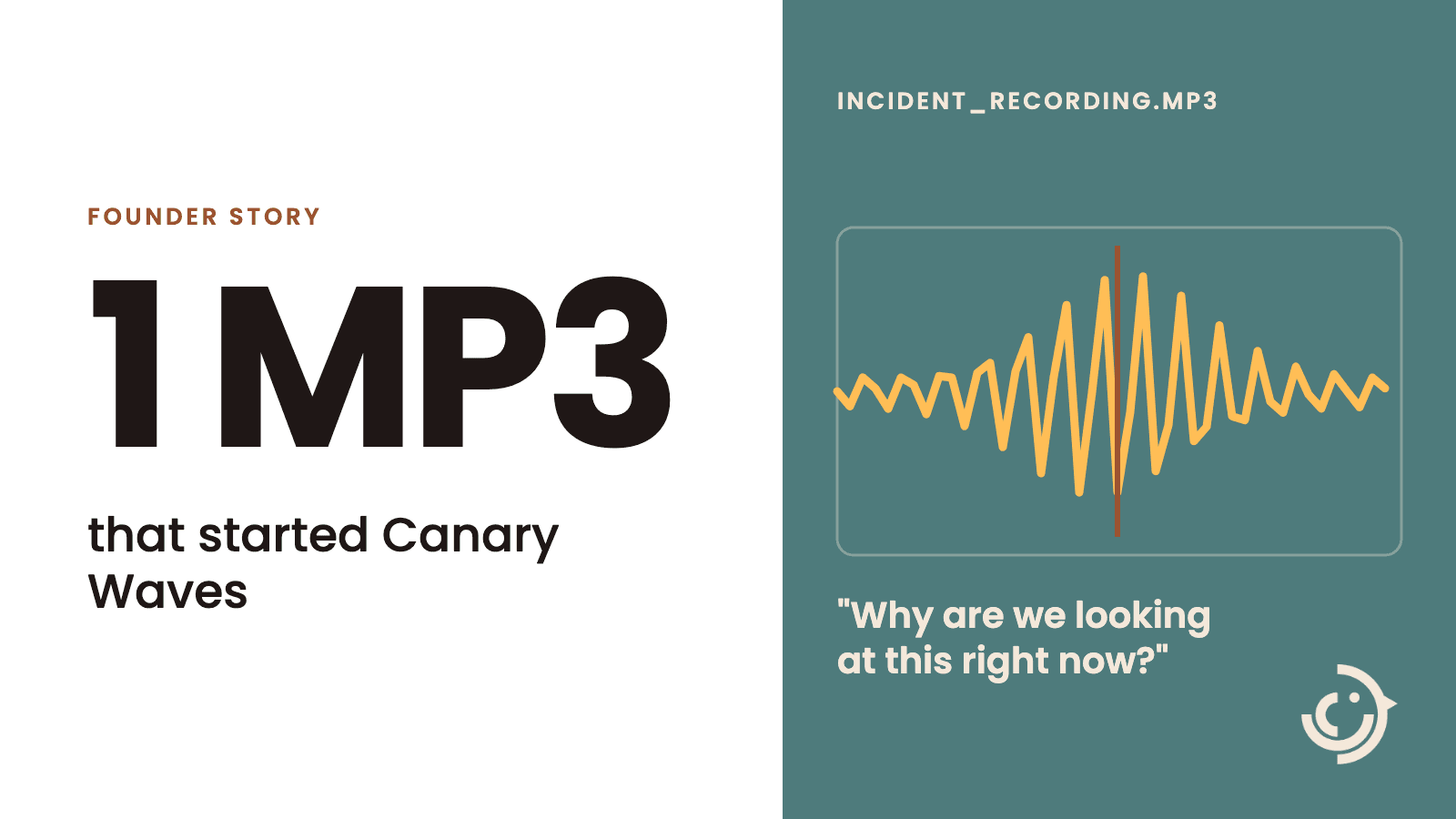
Jack was brought in as an independent reviewer. As in every serious investigation, the team gathered everything: training records, calibration records, video. And the recording of the two-way radio traffic from before, during and after the incident.
"I remember even at that time I was struck. Why are we looking at this right now? What if somebody called in this thing kicking back really hard three weeks ago, and we could have fixed it then?"
That was the seed. If a site is already recording its radio, the recording should not sit on a server waiting for the next investigation. It should be working for the people who made it. We wrote more about that idea in Your Mine's Most Underused Dataset Is Already on the Radio.
The part where it almost stalled
Good ideas are cheap. Jack's first attempt at building one went through a founder-matching program, with a co-founder who had built industry software before. They got as far as concepts and a wireframe of the interface. But the time zones never worked, and the partnership fell apart.
That left a mining engineer with "some decent chops in Python" and a product he could not build alone. Jack kept going anyway. He spent those years on the unglamorous work: building a rough prototype on test data, and talking to mine sites about what they actually needed. One answer came up again and again. They did not need another dashboard for the operations room.
Enter Julia: from GarageBand to a real product
The missing piece came from Jack's aggregates days. Julia Georgi had worked alongside him at Kraemer on aggregate pricing tools around 2017 and 2018, and had since built industry-specific software at two companies. When Jack reached out, she was looking for something new.
She did not say yes straight away. She sat in on two or three calls first. Then, in Jack's words, she said: "I want in. Let's make this a co-founding agreement. Let's go."
From there, Jack says, Julia and her team "took it from GarageBand to a real product."
Two co-founders, two very different jobs
The split works because the two roles barely overlap.
- Jack is the voice of the site. He knows how operations run, what a "hold at the decline" means and who to call at a mine. He builds the relationships with site teams, shapes what the product should do, and keeps it honest about how mining actually works.
- Julia builds and delivers. She leads the product and the technical team, turns site problems into software, and brings exposure to European mining and industry. She is also, by Jack's description, the person you want on a customer call.
"She's a really nice bulldog to have on calls, because she cuts through the BS. She tells customers, 'Look, we can't actually do this right now. We need to do this, this, this and this.' And her technical team is super, super strong."
That honesty is part of the product. Mining has seen plenty of technology that promised more than it delivered, which is why so many tools die on the frontline. A co-founder who tells a site what will not work yet is how you earn the right to come back.
Where it stands today
Canary Waves listens to the two-way radio a site already runs. It cleans up the scratchy audio, transcribes it with speech recognition tuned to the site's own names and mining vernacular, and turns the transcript into insights for decision-makers. Safety was the obvious way in. Early test work showed just as much value in operations: not only that a truck sat for 14 seconds, but why, based on what was said at the time.
At the time of the podcast, Canary Waves had launched and was running proof-of-concept testing with mine sites, including one in Australia, with more in discussion in Africa and North America. The approach is deliberately bottom-up: find champions at site level first, because enthusiasm at head office often gets lost by the time it reaches the pit or the decline.
Jack sums up the whole company in one line, and it is the line we keep coming back to:
"Canary Waves is not going to solve your problem. Your operators are already solving the problem. We're just giving you the tool to listen to them."
See the signals we surface, or follow Jack on LinkedIn for the mining memes he says are becoming his claim to fame.
See the signals we'd surface from a typical shift on your site. Book a 30-minute walkthrough.
FAQ
Who founded Canary Waves?
Canary Waves was co-founded by Jack Kellner, a geologist and mining engineer with experience at Kraemer Mining & Materials, Nevada Gold Mines and Rio Tinto, and Julia Georgi, a software entrepreneur who had built industry-specific tools for aggregates and mining. Jack leads site relationships and product direction; Julia leads the product and technical team.
How did the idea for Canary Waves start?
During an incident investigation at Long Canyon, a Nevada gold mine, investigators used a recording of the site's two-way radio to reconstruct what happened. Jack asked why that data was only used after an injury, when the warning might have been called in weeks earlier. That question became Canary Waves.
Why did Canary Waves start with safety?
Safety is where mine sites are most open to new tools, so it is the natural entry point. Early testing quickly showed the same radio data also explains operational problems, such as why trucks were delayed at a certain point, and supports maintenance by catching equipment issues as soon as they are called in.