Shift handover in mining has a quiet failure point: crews say the important things out loud, on the radio, during the shift. Then the shift ends, and the written handover keeps only what someone remembered to write down at the end of a long day.
This post looks at what major accident investigations say about handover, what the radio carries that the handover sheet does not, and what leaders can do to close the gap.
Why shift handover in mining is where safety information gets lost
Handover is one of the few moments when a whole operation's picture of itself has to pass from one group of people to another in a few minutes. Equipment status, road conditions, open hazards, work in progress, what dispatch rerouted overnight and why. It all has to move across, and it all moves at the worst possible time: when the outgoing crew is tired and thinking about getting home, and the incoming crew hasn't seen current conditions yet.
The UK Health and Safety Executive puts it bluntly: many accidents have occurred because of failures of communication at shift handover, most of them involving planned maintenance work. Its examples include Piper Alpha, where information about the status of equipment didn't make it across the shift change, and the 1983 Sellafield discharge, which followed a failure of communication between shifts.
The closest parallel to a mine radio is the 2005 BP Texas City refinery explosion, where fifteen workers were killed and 180 others were injured. A review of the investigation in an IChemE Hazards 24 paper on shift handover sums up what went wrong at the shift turnover. The night operator left early, so the handover didn't involve the person who had done the work. The shift log was brief and ambiguous. And key messages were not written down but passed verbally over phone and radio, then interpreted differently by different people.
The same paper describes Buncefield, where the handover documentation was designed to record the situation at the end of the shift, not the events that happened during it. That is exactly the shape of the problem on a mine site. The written handover is a snapshot. The radio is the movie.
What gets said on the radio in the last and first hour
In the last hour before shift change, the radio carries the outgoing crew's picture of the site. Much of that is information the next crew needs, but it is not said with the next crew in mind.
Three kinds of radio traffic tend to fall through the gap:
- Outgoing crew warnings. Warnings about a soft spot on a decline or a berm getting low. The operator who said it may assume it's handled because they said it, and dispatch may assume the next crew will hear it.
- Hazards mentioned in passing. Rock on the haul road, water pooling at a dump point, a light vehicle parked somewhere odd. These come up mid-conversation, get acknowledged, and disappear. In one operation's radio traffic we analyzed, crews called out dozens of hazards over the air in five days, and the question of how many were ever logged is the same question handover raises.
- Equipment notes. A unit reported running hot again, or brakes feeling soft on the loaded run. Small mentions that, stacked across a shift, can describe a machine heading for trouble. If they reach the handover note at all, they may shrink to a single line.
The first hour of the next shift has its own pattern. Operators asking whether a bypass is still closed or where the grader is working are telling you, in real time, what the handover didn't cover. Those questions are useful data. They show exactly which pieces of the picture didn't make it across.
None of this is anyone's fault. People at the end of a long shift are tired, and the HSE notes that accidents and injuries are more frequent on night shifts and when shifts are long. The handover lands right at the end of that.
Informal records already hold the safety picture
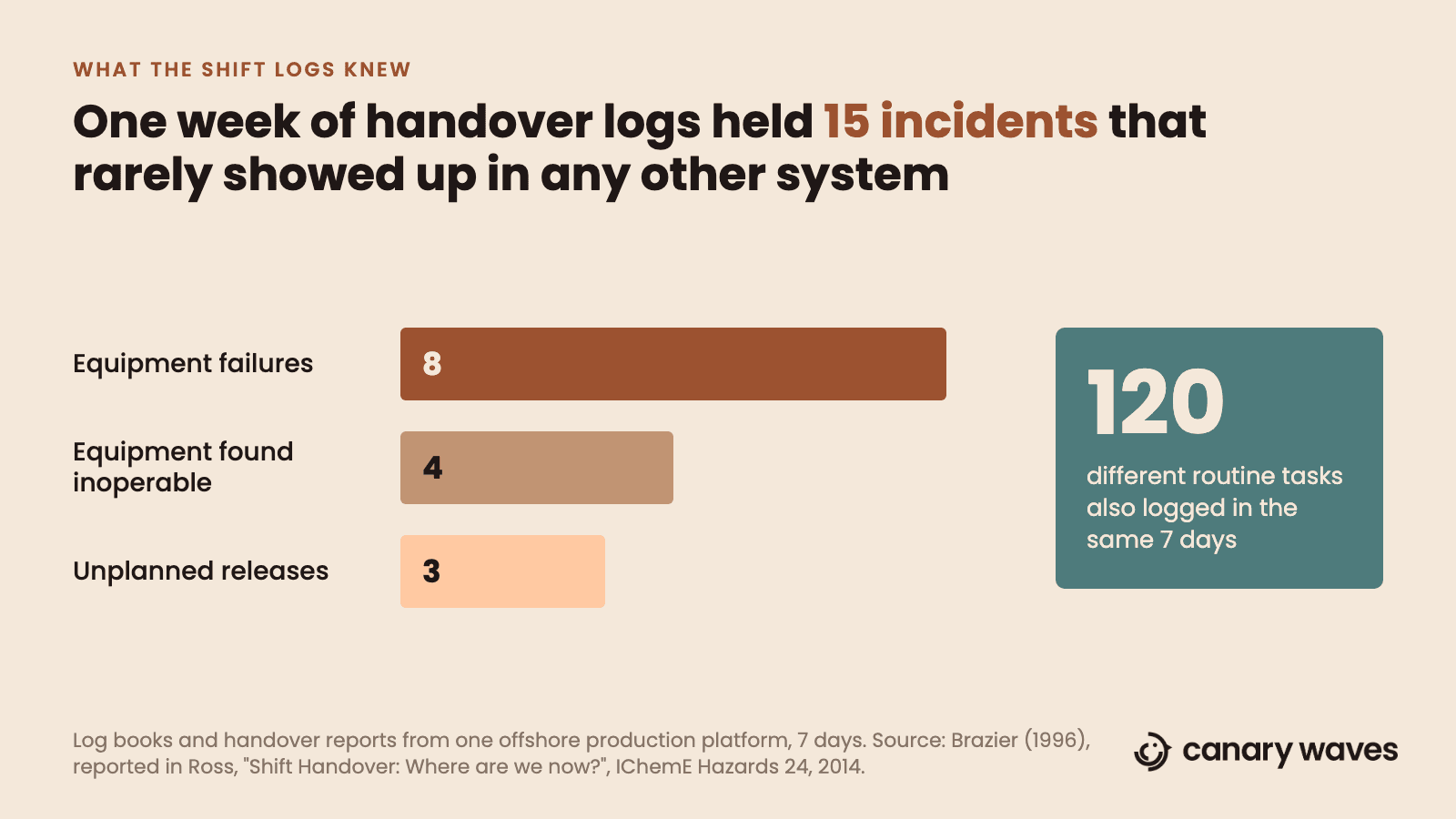
There's an older study that makes the point well. Researchers collected seven days of log books and handover reports from one offshore production platform and went through them line by line. Those informal records held events that rarely showed up in any formal system. According to the summary in the IChemE paper, the logs contained 15 events that could be considered incidents and 120 different routine tasks, alongside a list of small human errors and improvised fixes.
Now think about what sits one layer below the log book on a mine site. The log is what someone chose to write. The radio is what everyone actually said, all shift, with the time and the location attached. If the written log already holds safety information that formal systems miss, the radio is likely to hold more.
Regulation points the same way. MSHA's workplace examination rule for metal and nonmetal mines requires a competent person to examine each working place at least once each shift, before miners begin work, and record conditions found before the end of the shift. That's a strong foundation. But it covers what the examiner found on the walk, not a hazard an operator mentioned on the radio during the shift.
Signals that the handover is about to miss something
These signals tend to mean a piece of the picture won't make it across:
- Warnings acknowledged with a promise to pass them on. Said in good faith by dispatch or a supervisor, often with other things already waiting to be passed on, and with no written record.
- Conditions described as having been that way all shift. Something this crew has adapted to, and the next crew has never heard of.
- Hazards mentioned in passing. Often at the end of an unrelated call.
- First-hour questions about whether a route is still closed. Traffic from the incoming crew. Every one of these is a handover gap you can count.
- Incoming crews saying they were not told. A handover that already failed.
What leaders can do about shift handover
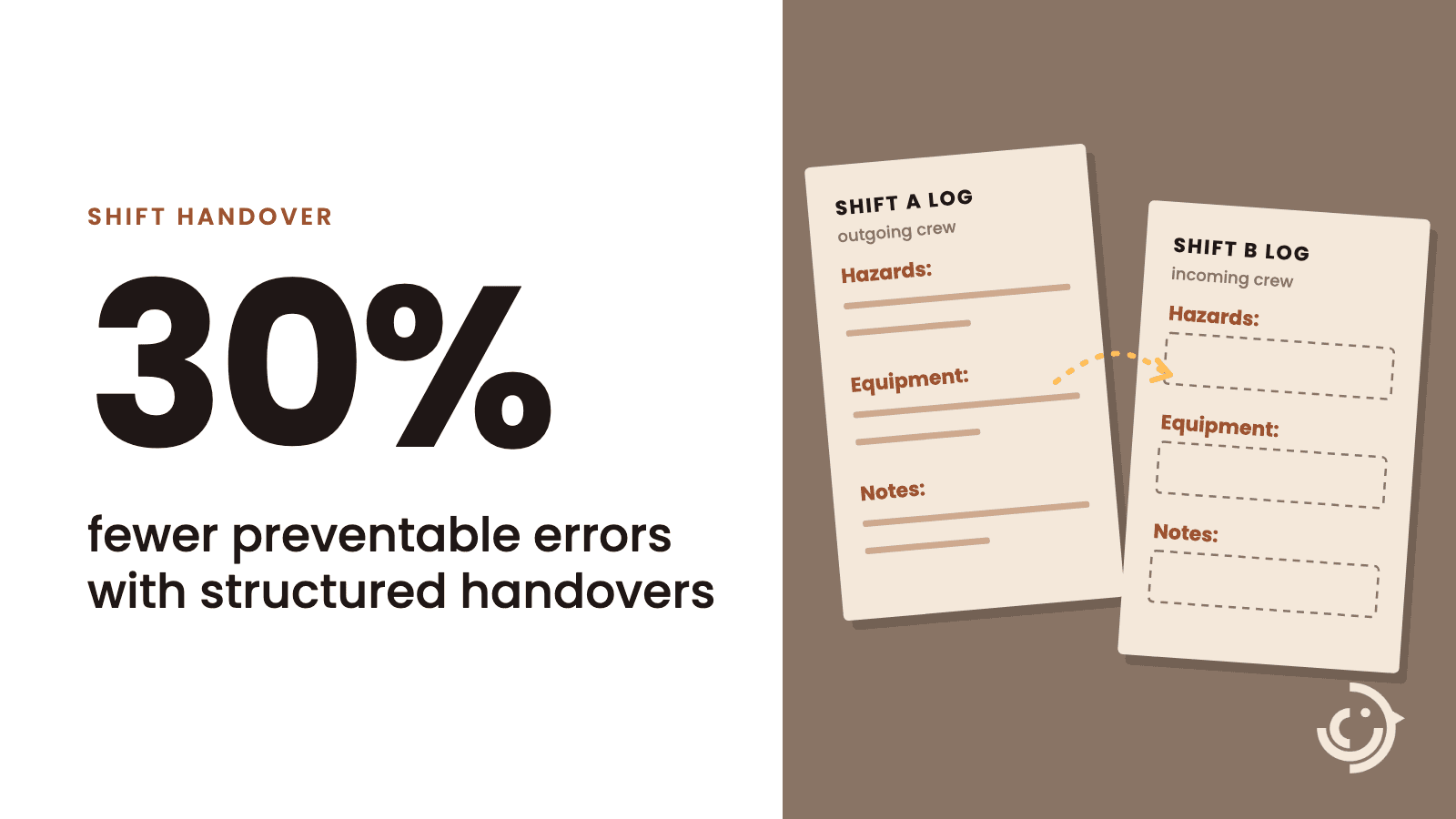
The best evidence for structured handover comes from hospitals, where handoffs have been studied closely. When nine hospitals introduced a standard format for verbal and written handoffs, plus training and observation, preventable adverse events fell by 30% and medical errors by 23% across 10,740 admissions. Verbal handoffs didn't get longer, at 2.4 minutes per patient before and 2.5 after. Structure, not extra time, did the work. A mine isn't a hospital, but the lesson travels.
Here's what translates to a mine site, no new technology required:
- Use a fixed structure. Same headings every shift: haul roads and declines, open hazards, equipment status, work in progress, reroutes and closures, anything unusual. A structure makes gaps visible. A blank under "open hazards" invites the question.
- Do it face to face, both ways. The HSE recommends handover that is face to face, two-way, and uses both verbal and written communication. The written sheet is the checklist. The conversation is where the incoming supervisor asks about the decline.
- Build in overlap. Even fifteen minutes of overlap between outgoing and incoming supervisors, or a short in-cab or hot-seat changeover where operators swap at the machine, beats a sheet left on a desk. Plan rosters so handover isn't squeezed into the most tired minutes of the shift; KB&G's primer on fatigue in mining covers how rosters wear crews down.
- Make dispatch the handover hub. Dispatch hears more of the shift than anyone. Give the outgoing dispatcher time to brief the incoming one, and a place to note every warning they passed on. We wrote about the hidden load on mine dispatch in an earlier post.
- Write warnings when they're said, not at the end. Ask supervisors to jot hazards into the handover as they come up during the shift. The end-of-shift snapshot is where Buncefield's handover went wrong.
- Use the start-of-shift meeting. Read out the open hazards from the last shift at the pre-start, and give crews a moment to add what they know. KB&G's guide to safety shares in mining has practical ideas for keeping those meetings useful.
- Listen to the first hour. Have someone track first-hour questions about whether a route is still closed, for a couple of weeks. Each one points at a heading your handover template is missing.
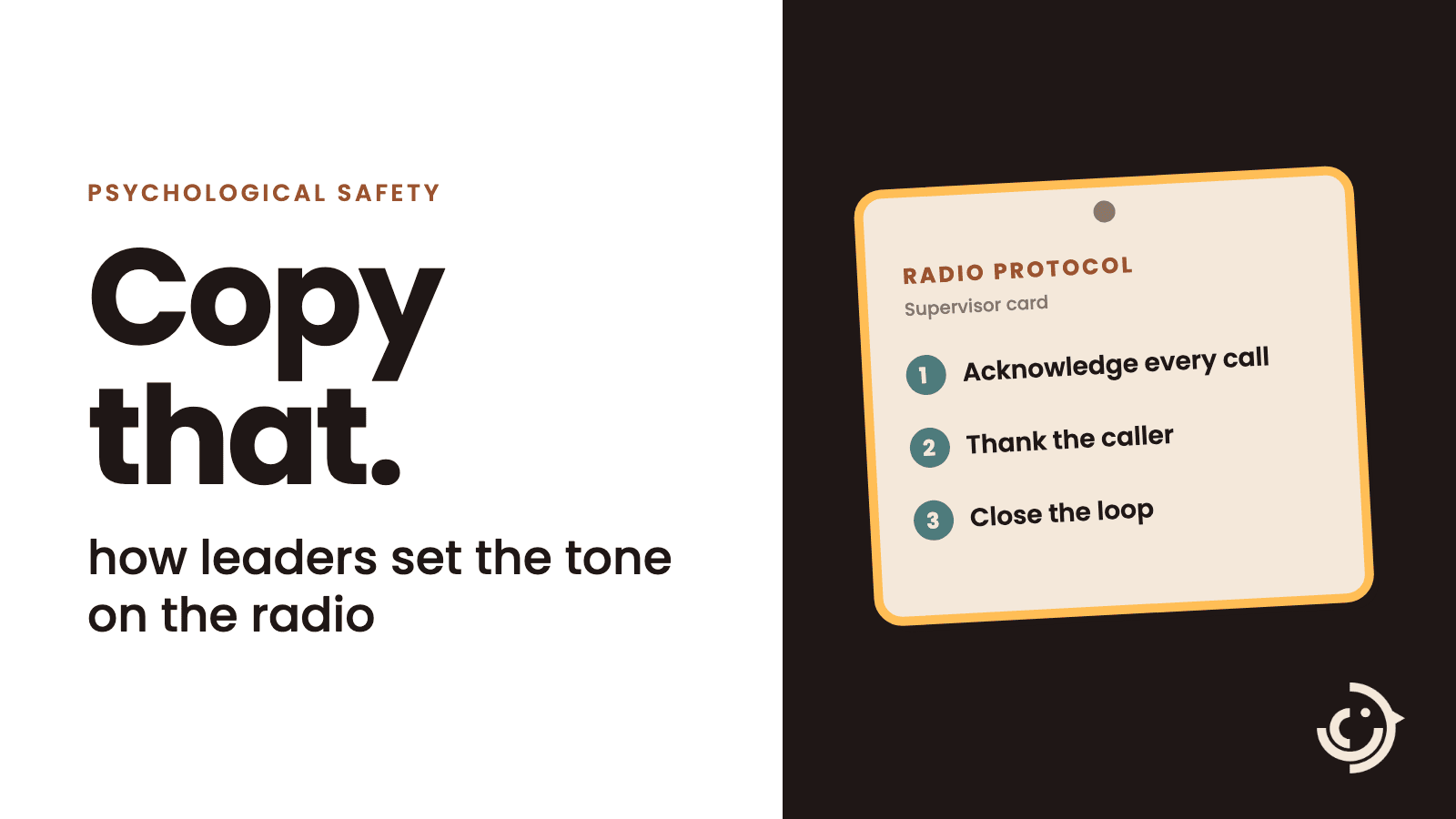
- Tighten radio protocol around shift change. Clear call signs, read-backs for hazards, and a standard "handover call" from each crew to dispatch before parking up. KB&G covers the basics of radio communication in mining well.
Where Canary Waves fits
Canary Waves connects passively to the two-way radio a site already runs and transcribes the traffic, tuned to site slang and equipment names. It flags hazard mentions, equipment stress and skipped protocols, then builds a shift-level summary of what was actually said, by location and time. The incoming supervisor gets the hazard on the decline and the unit running hot, even if nobody wrote them down. Operators don't change a thing. See the kinds of signals we surface, or how the same idea applies to near-miss language at peak congestion.
When the warning is already on the radio, preventable should mean prevented.
See the signals we'd surface from a typical shift on your site. Book a 30-minute walkthrough.
FAQ
What is shift handover in mining?
Shift handover is the transfer of information and responsibility from an outgoing crew to an incoming one. On a mine site it covers haul road and decline conditions, open hazards, equipment status, work in progress, closures and reroutes. Done well, it is structured, face to face, and backed by a written record the next crew can check.
Why is shift change a high-risk time on a mine site?
Shift change is when the outgoing crew is most tired and the incoming crew knows least about current conditions. Information said during the shift, often over the radio, has to be summarized in minutes. Major accident investigations, including Piper Alpha and Texas City, found that critical information was lost at shift handover.
What should a mining shift handover include?
At minimum: haul road and decline conditions, open hazards and where they are, equipment faults and units to watch, work in progress, closures and reroutes, weather or lightning holds, and anything unusual. Use the same headings every shift, so a blank section prompts a question rather than an assumption that nothing happened.
How can radio traffic improve shift handover?
Crews already say most of the important things on the radio during the shift: warnings, hazards, equipment notes. When that traffic is captured and summarized by location and time, the incoming supervisor sees what was actually said, not just what someone remembered to write at the end of a long shift.
Does a better handover take longer?
Not necessarily. In a large hospital study, a structured format for verbal and written handoffs cut preventable adverse events by 30% without lengthening verbal handoffs, which averaged 2.4 minutes per patient before and 2.5 after. Structure helps people cover the right ground in the same time.