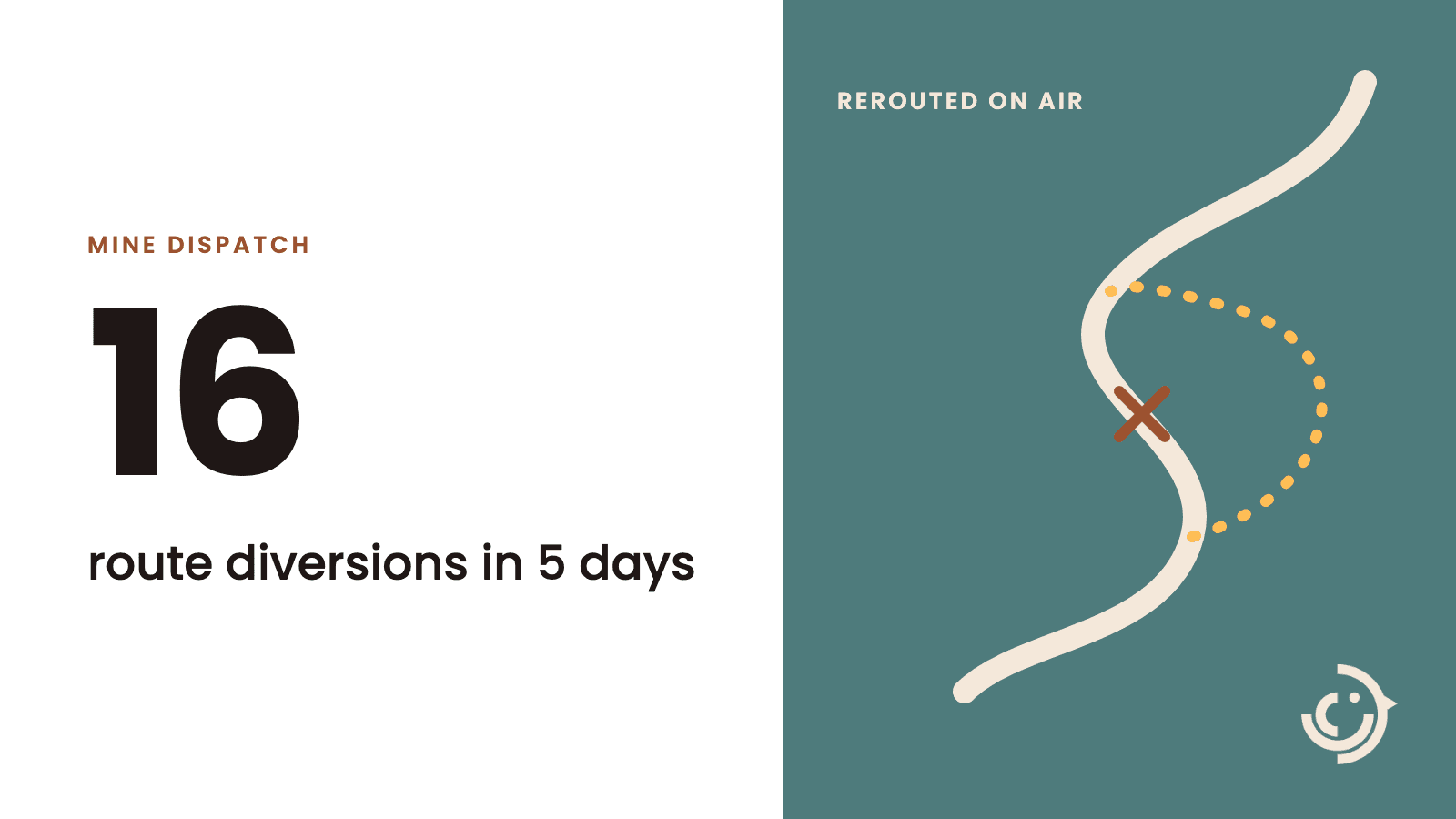
In one 5-day window at one underground operation, mine dispatch rerouted traffic over the radio 16 times. Sixteen route diversions: bypass closures, blocked declines, rerouted on the fly. Each one sounded like a small call. Stacked up, they steadily reduced throughput and created confusion about which way crews should actually be moving. And because every diversion was decided in the moment, there was no record of how often it happened, where, or what it cost.
That is the nature of a diversion: a fast decision, made by voice, that leaves no trace unless someone writes it down.
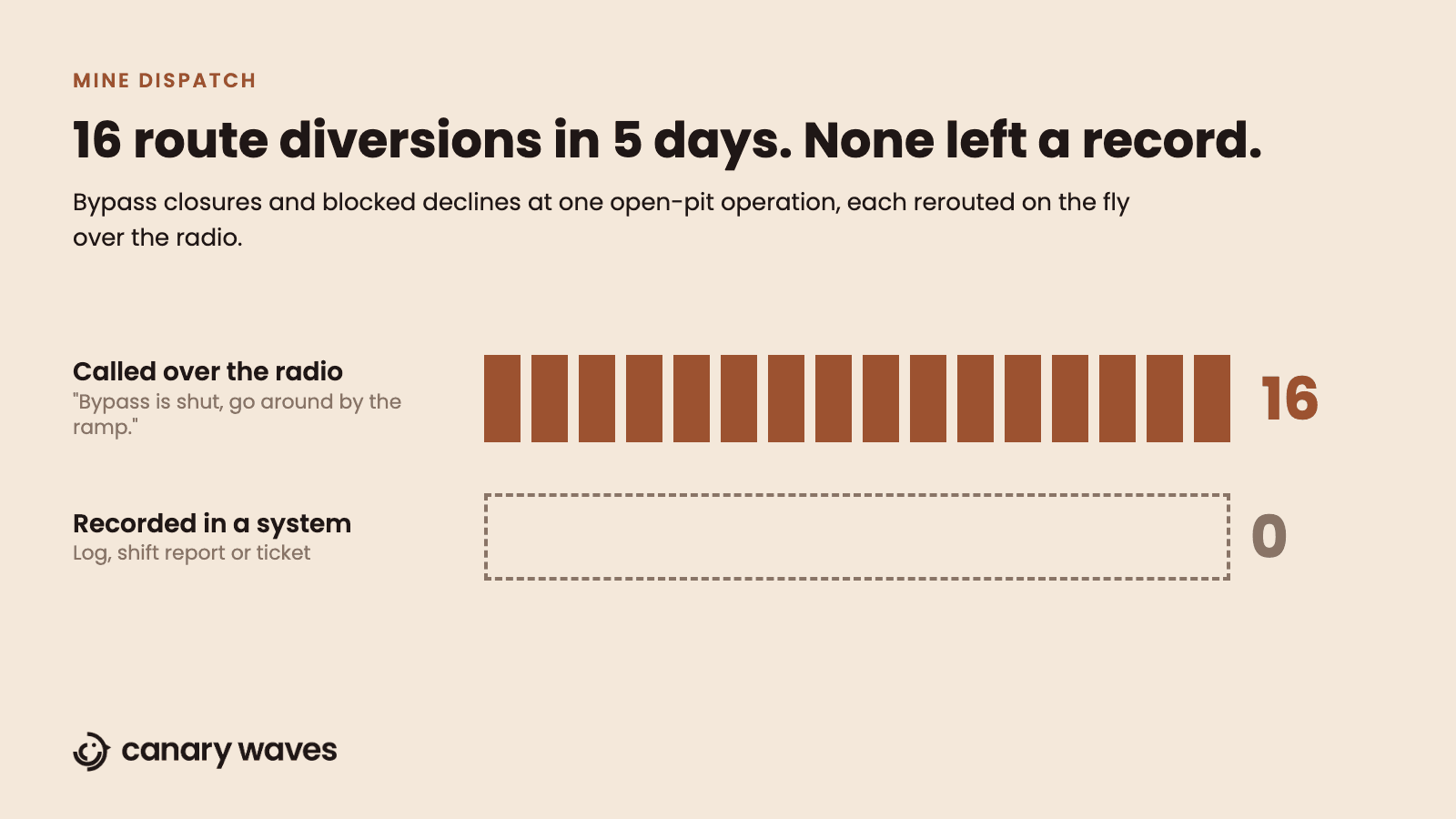
Why route diversions are a mine dispatch problem worth measuring
A single closed bypass is a minor inconvenience. Sixteen in a week is a pattern, and patterns are what leaders can fix. The trouble is that diversions sit in a gap between teams. The road crew knows the bypass was shut. Dispatch knows trucks went the long way. Production sees a soft shift. No single team holds all three pieces.
Direction of travel is a compliance matter, not just a preference. Under 30 CFR 56.9100, every US surface metal and nonmetal mine must establish and follow rules governing speed, right-of-way, direction of movement and the use of headlights, and must place signs or signals warning of hazardous conditions. A diversion called over the radio changes the direction of movement for part of the operation in real time. If it is not clear who heard it, the traffic rules on paper and the traffic on the road can drift apart.
Confusion is the documented risk. When the NSW Resources Regulator reviewed 46 vehicle interaction incident notifications over six months in 2024, it found the predominant causes were a lack of, or inadequate, communication between the people involved and a lack of situational awareness on the part of operators. A truck that missed the reroute call, or heard it and was not sure, is exactly that situation.
Regulators expect hazards on mobile equipment routes to be identified. MSHA's safety program rule for surface mobile equipment requires operators to have written safety programs for surface mobile equipment that identify hazards and risks, developed with input from miners and their representatives. A route that keeps closing is a hazard and a risk. If it only ever lives on the radio, it is hard to show you identified it.
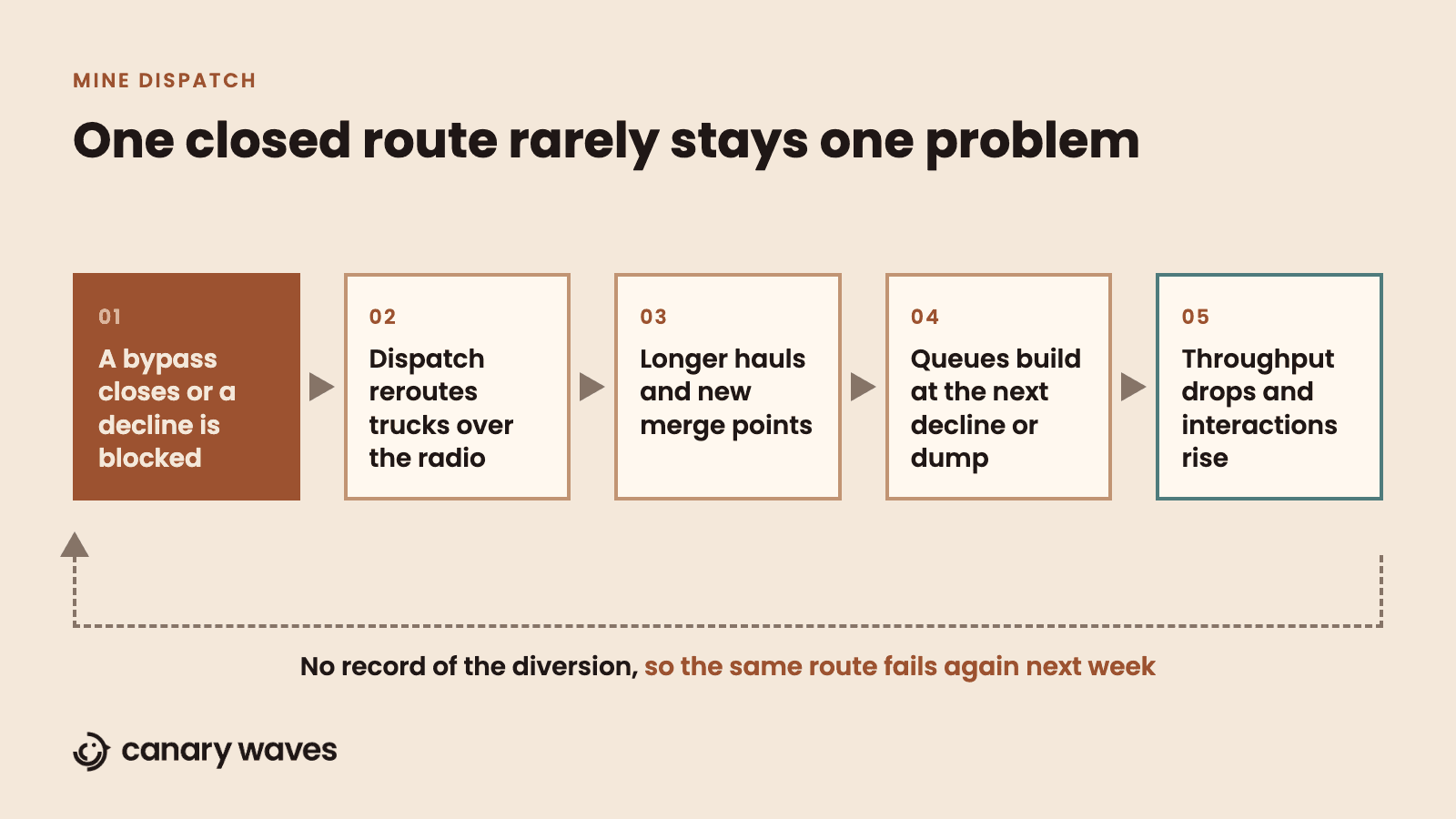
The knock-on effects add up. A rerouted fleet means longer hauls and new merge points. New merge points mean queues at the next decline or dump. On the same operation, those queues showed up as more than 365 "holding" calls in the same five days, which we unpacked in Haul Road Congestion: What 365 "Holding" Calls Reveal.
There is also a human cost that never shows up in a report. During a diversion the dispatcher is doing three jobs at once: rerouting trucks, answering repeat requests for directions, and still running the normal flow of loads, breaks and equipment moves. Nobody sees that extra load, because the only evidence of it is a busier channel. When diversions stack up, the dispatcher is working at the edge of what one set of ears can track. That is the hidden load on mine dispatch, and it is a fair reason to measure it.
Signals to listen for on the dispatch channel
Diversions are not always announced with a formal name. Signals to listen for:
- Closure calls. A bypass or road reported shut. Note the time, because the reopening may never be announced.
- Reroute instructions. An instruction to take a ramp or an alternate road. It changes the traffic pattern for every truck on that circuit.
- Repeat requests for directions. One is normal. Several on the same diversion means the message did not land cleanly.
- Blocked declines. Often reported with the cause attached, such as rock on the road or a loader on the ramp. That cause is worth keeping.
- Questions about whether a closed route is open yet. These tell you the reopening was not announced.
None of this is poor radio discipline. Dispatchers and operators are solving a live problem with the tool they have. The gap is that radio has no memory.
What mine dispatch teams can do about diversions
You can start building a picture of your diversions this week, without any new system.
- Keep a diversion log at the dispatch desk. Four columns: time closed, location, reason, time reopened. It takes ten seconds per entry. After a week you will know which routes fail most often.
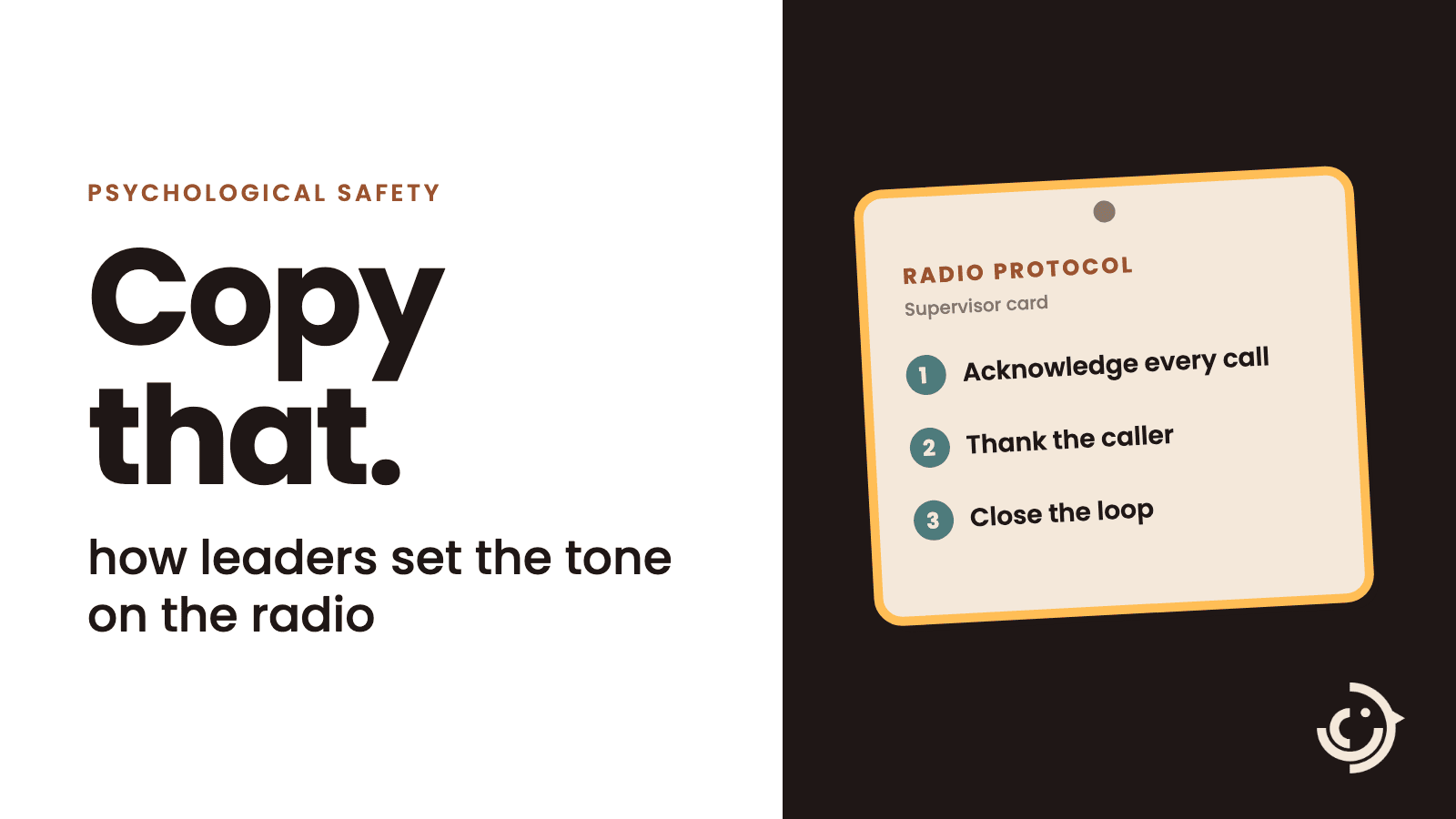
- Close the loop on every reroute. Make an all-trucks acknowledgement standard for any change in direction of travel, and make the reopening call as formal as the closing call, since it is the easiest one to skip.
- Tie diversions to the reason. Grader on the road, rock on the decline, water, blasting, a broken-down unit. Recurring reasons point at different owners: road maintenance, ground control, drill and blast, or maintenance.
- Review the log weekly with the road crew and production. Put the three teams that each hold one piece of the story in one room for fifteen minutes. The route that closed four times is your candidate for a permanent fix: a second access, a better maintenance window, a scheduled grader slot outside peak haul.
- Check where the rerouted traffic went. Look at holds and near misses on the alternate route during each diversion. If queues jump at the next decline, the real cost of the closure is there, not on the closed road.
- Add repeat diversions to your mobile equipment hazard review. If a route keeps failing, it belongs in the written program as an identified hazard, with operators' input on how they want reroutes communicated.
The same habit of logging what is said on the radio applies to hazards as well. Our post on 37 hazards called out on the radio in 5 days looks at how many verbal hazard calls ever reach a system where follow-through can be tracked.
Where Canary Waves fits
A paper diversion log works when dispatch has a quiet moment. Busy shifts are when it slips. Canary Waves connects passively to your existing two-way radio and captures every diversion as it is called: what closed, where, why, when traffic was rerouted and when normal routing resumed. Leaders see which routes keep failing, how often, and where a permanent fix would pay for itself. No new hardware, nothing new for dispatchers or operators to do. See the full set of signals we surface, or the whole 5-day picture in What One Operation's Radio Said in 5 Days.
You can't optimize what you never measured.
See the signals we'd surface from a typical shift on your site. Book a 30-minute walkthrough.
FAQ
What is a route diversion in mining?
A route diversion is any change to the planned haul route because a road, bypass, ramp or decline is closed or blocked. Causes include grading, rock on the road, water, blasting or a broken-down unit. Dispatch usually reroutes trucks by radio in the moment, which means the change often goes unrecorded once the shift ends.
How do route diversions affect mine dispatch and throughput?
Each diversion adds haul distance and creates new merge points, which build queues at the next decline or dump. One diversion is minor. Repeated diversions steadily cut throughput and create confusion about which way crews should move. In one 5-day window at one underground operation, we counted 16 diversions, all rerouted over the radio.
Are mines required to set rules for direction of travel?
Yes. In the US, 30 CFR 56.9100 requires surface metal and nonmetal mines to establish and follow rules governing speed, right-of-way, direction of movement and headlight use, and to post signs or signals warning of hazards. A radio reroute changes direction of movement in real time, so it should be communicated clearly and acknowledged.
How can dispatch track route diversions without new technology?
Keep a simple log at the dispatch desk: time closed, location, reason and time reopened. Require all trucks to acknowledge reroutes, and announce reopenings as formally as closures. Review the log weekly with road maintenance and production. Routes that fail repeatedly become candidates for a permanent fix and belong in your hazard review.
Why do vehicle interactions rise when routes change?
Reroutes send traffic onto roads and intersections not planned for that volume, and not every operator hears or understands the call. The NSW Resources Regulator found that poor communication and low situational awareness were the predominant causes of 46 vehicle interaction notifications over six months in 2024. Diversions stress both at once.