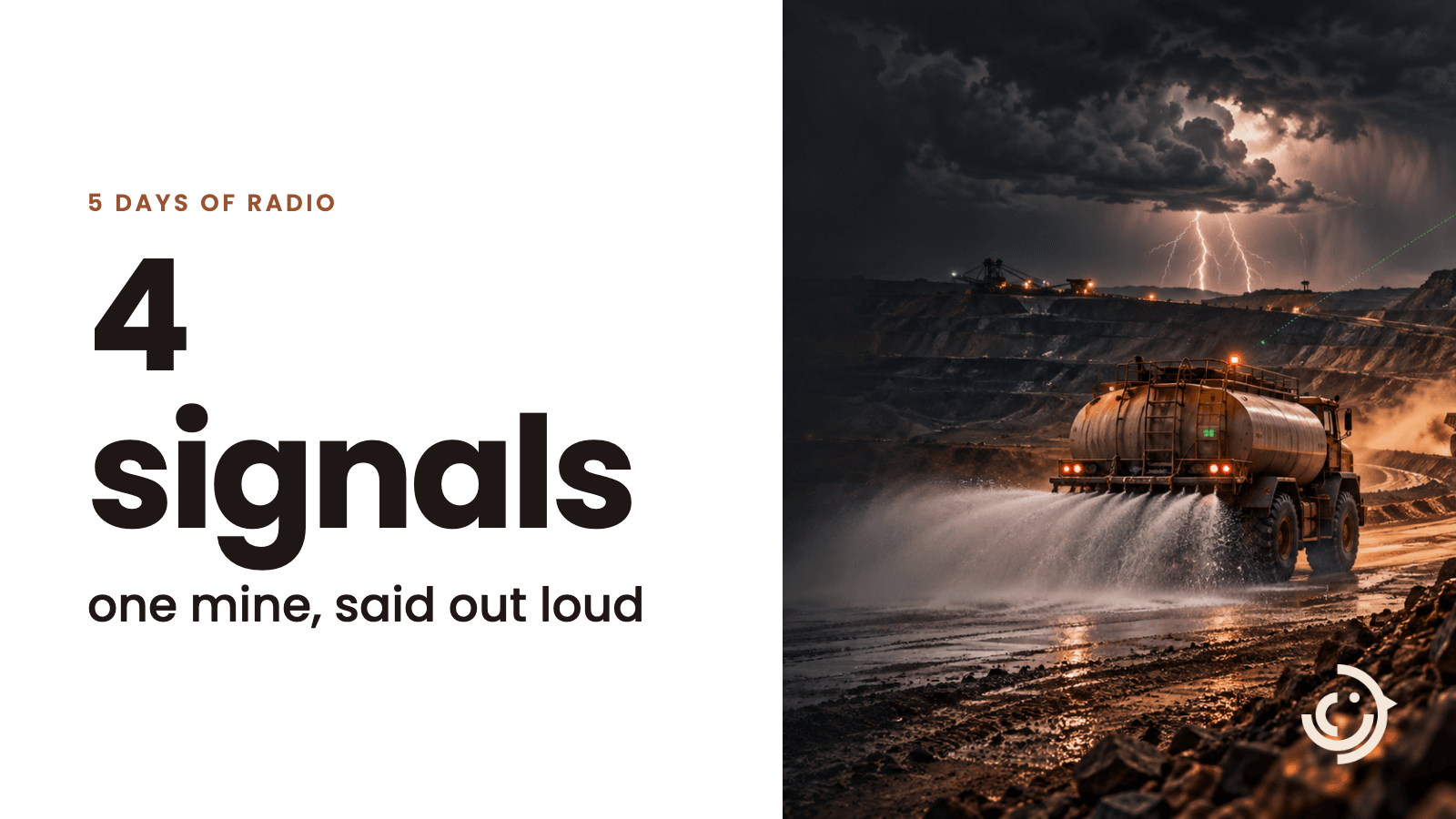
Over a single 5-day window, March 1 to 5, we analyzed all of the radio traffic from one underground operation. The radio carried more than 365 holding calls, 28 overheating reports, 37 hazard calls and 16 route diversions. Each call was routine on its own, and none of them looked like a line in anyone's mining safety ROI case. They should have.
Read together, those everyday calls told a story that no report on site was telling. This post pulls the whole picture into one place, and makes the case for a safety return built on a dataset the site already owns.
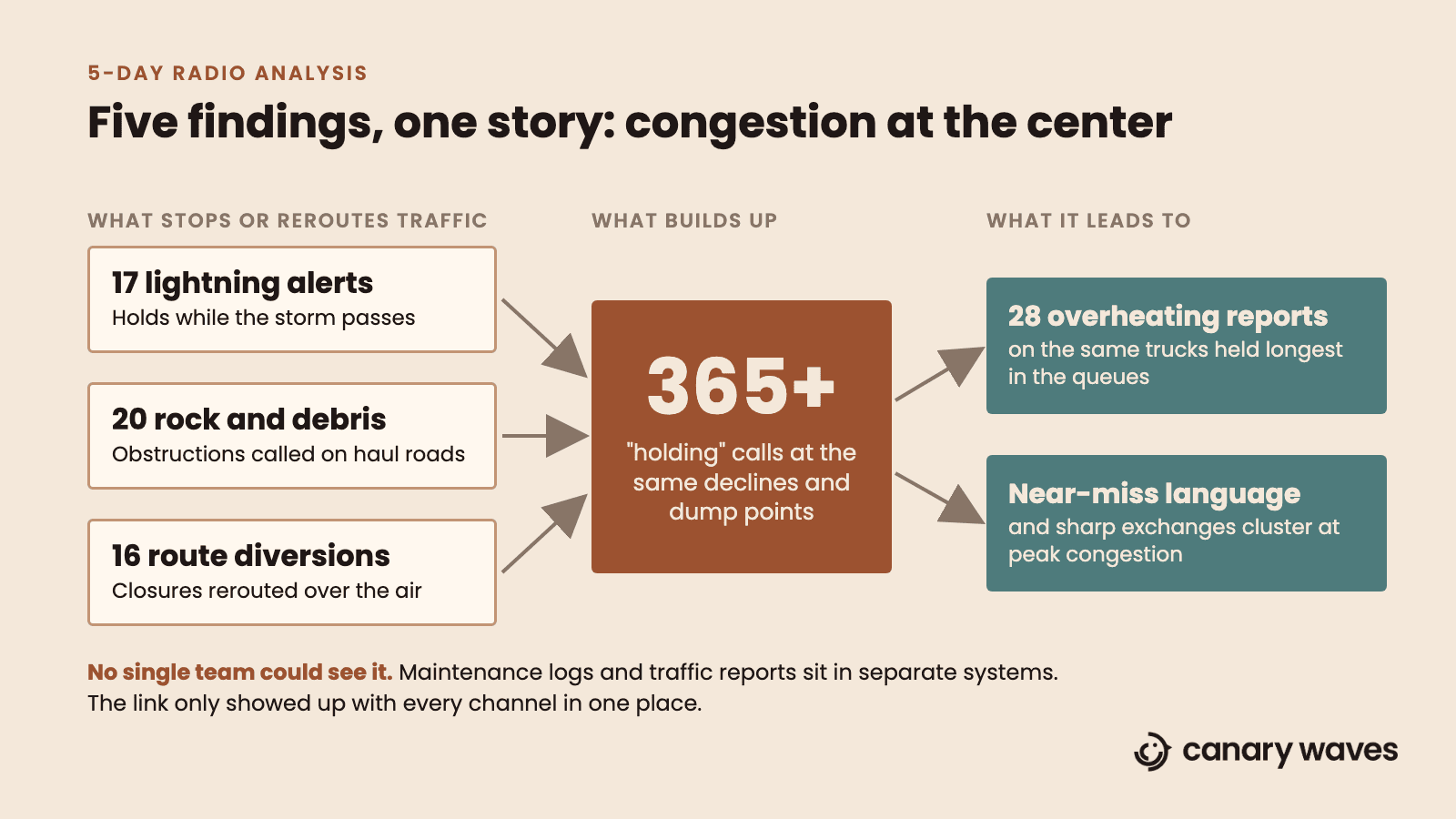
What the radio said in 5 days
Here is what crews said out loud, over five days, from March 1 to 5. Each finding has its own deep dive if you want the detail.
365+ "holding" calls mapped the bottlenecks
"Holding." "Still holding." "Hold at the decline." That word crossed the radio more than 365 times. The holds bunched at the same declines and dump points, every shift. Each call sounds like nothing. Together they are a map of the constraints capping throughput. More in Haul Road Congestion: What 365 "Holding" Calls Reveal About Bottlenecks.
28 overheating reports warned before failure
Crews reported overheating 28 separate times, repeated on specific units and clustering under idle and load conditions. Read together, they described a cooling system under growing strain, days before it failed. More in Haul Truck Overheating: The Radio Warnings Hours Before Failure.
Congestion was cooking the fleet
The trucks held longest in queues, at declines, at dump points and during lightning holds, were the same trucks throwing overheating warnings hours later. Maintenance logs and traffic reports sit in separate systems owned by separate teams, so nobody saw the link. More in When Congestion Cooks the Fleet.
16 route diversions, decided on the fly
Sixteen times in five days a route closed and dispatch rerouted the fleet over the radio. Bypass closures. Blocked declines. Each one was a small decision with no record of how often it happened or what it cost. More in 16 Route Diversions in 5 Days: The Hidden Load on Mine Dispatch.
37 hazards called out on air
Crews flagged 37 safety hazards over the radio: 17 lightning alerts and 20 rock and debris obstructions. The calls reached the right people. Whether each one was tracked to a fix is much harder to say. More in 37 Hazards Called Out on the Radio in 5 Days. How Many Got Logged?
Near-miss language spiked with congestion
Near-miss warnings and sharp, aggressive exchanges didn't land at random. They clustered tightly around the peak congestion periods. When the queues built, so did the stress in people's voices. More in Stress on the Radio: Why Near-Miss Language Spikes With Congestion.
None of it was hidden. All of it was said out loud, every shift, to supervisors and dispatchers who couldn't possibly catch it all in real time. That is the core idea behind our first post, Your Mine's Most Underused Dataset Is Already on the Radio.
Why mining safety ROI starts with signals you already hear
Safety ROI conversations usually start with a new system, a capital request and a payback period. This analysis points somewhere cheaper. The early warnings were already there. The return comes from catching more of them. A few industry numbers show why that matters.
- Haulage is still the biggest killer. US mining recorded 33 miner deaths in 2025 by trade-press count, up from 26 in 2024. Powered haulage led with 13 (Pit & Quarry, January 2026). Congestion, rerouting and stressed exchanges between trucks all sit inside that category.
- The global trend is going the wrong way. ICMM member companies reported 42 fatalities in 2024, up from 36 in 2023 and 33 in 2022. Nine involved mobile equipment and transportation, and five were fall-of-ground incidents. ICMM says it is revising its critical control guidance (ICMM, July 2025).
- The cost of getting it wrong is large. The National Safety Council puts the cost of a work-related death at $1.54 million and a medically consulted work injury at $48,000 in 2024, counting wage losses, medical and administrative expenses and employer costs (NSC Injury Facts). Those are societal costs, before equipment damage or lost production.
Now set those numbers next to the radio. The same five days that carried 37 hazard calls also carried 28 overheating warnings and hundreds of holds. A single thermal failure caught early, a single repeat hazard fixed for good, or a single congested hour flagged while it was still building can each pay for a lot of listening. We won't put a dollar figure on this operation. The point is that the warnings were free, and most of them went unused.
There is a second return that rarely makes it into the spreadsheet. Every hold, diversion and heat call that gets captured becomes evidence. It tells you where to spend on road design, which units need a cooling-system check, and which procedures crews are working around. That turns safety spending from a guess into a decision you can defend.
Signals to listen for when the whole picture is building
You don't need a full analysis to start hearing it. Repeated across a shift, these signals tell you more than any single call:
- Repeated holds at the same location, shift after shift. A bottleneck, not bad luck.
- Repeated heat complaints from the same unit. A maintenance warning that hasn't reached maintenance yet.
- Closures and reroutes announced on air. A diversion that dispatch is absorbing on the fly.
- The same hazard called twice. The first call didn't land.
- Short, sharp replies where a routine acknowledgement would normally be. Stress building in the queue.
What good sites do with their radio traffic
Plenty of this can start with nothing more than a notebook and a weekly meeting.
- Sample one shift a week. Pick a recorded shift and have someone listen through the busiest two hours. Note every hold, heat call, diversion and hazard. Patterns show up fast.
- Put maintenance and dispatch in the same room. Compare the trucks that queued longest with the trucks that threw heat warnings. If they overlap, you have found your own congestion and overheating loop.
- Log the small stuff at dispatch. Holds, diversions and hazard calls, with time and place. A shared sheet is enough to start.
- Review repeat locations. The same decline, the same dump point, the same switchback. Permanent fixes there usually beat any amount of extra vigilance.
- Keep asking nothing new of operators. The crews are already doing their part by talking. Any process that adds forms or apps to the cab tends to fade, as we covered in Why Mine Safety Tools Die on the Frontline, and What Survives.
The limit is people and time. One listener can sample a shift. Nobody can listen to every channel, every shift, and connect what maintenance hears with what dispatch hears.
Where Canary Waves fits
Canary Waves connects passively to the radio your site already runs, every channel and every shift, and turns that traffic into shift-level summaries for safety and operations leaders. It structures holds, heat warnings, diversions, hazards and stress language by location, unit and shift, so links like congestion and overheating show up while the shift is still running. No new hardware, nothing changes for operators. See the signals we surface.
A note on the data: these findings come from an underground mine, which is why the decline comes up so often. We have seen that Canary Waves can provide even more insights at open pits, where operations and traffic patterns are more fluid.
The operations pulling ahead aren't working harder. They're hearing more.
See the signals we'd surface from a typical shift on your site. Book a 30-minute walkthrough.
FAQ
What is the ROI of mining safety technology?
Mining safety ROI comes from incidents, failures and delays that don't happen. NSC estimates a work-related death costs $1.54 million and a medically consulted injury $48,000, before equipment damage or lost production. Tools that use data a site already generates, like radio traffic, can deliver that return without new hardware or extra work for operators.
What can mine radio traffic reveal in a few days?
In five days of one underground operation's radio, routine calls added up to a bottleneck map, an early warning on a failing cooling system, a record of route changes nobody had logged, and a clear link between congestion, equipment heat and stress on the radio. None of it needed new hardware.
Do we need new hardware to analyze mine radio?
No. Canary Waves connects passively to the two-way radio a site already uses. Operators keep talking exactly as they do today. The traffic is transcribed, tuned to site slang and equipment names, and turned into shift-level summaries for leaders. A proof of concept can typically run within weeks.