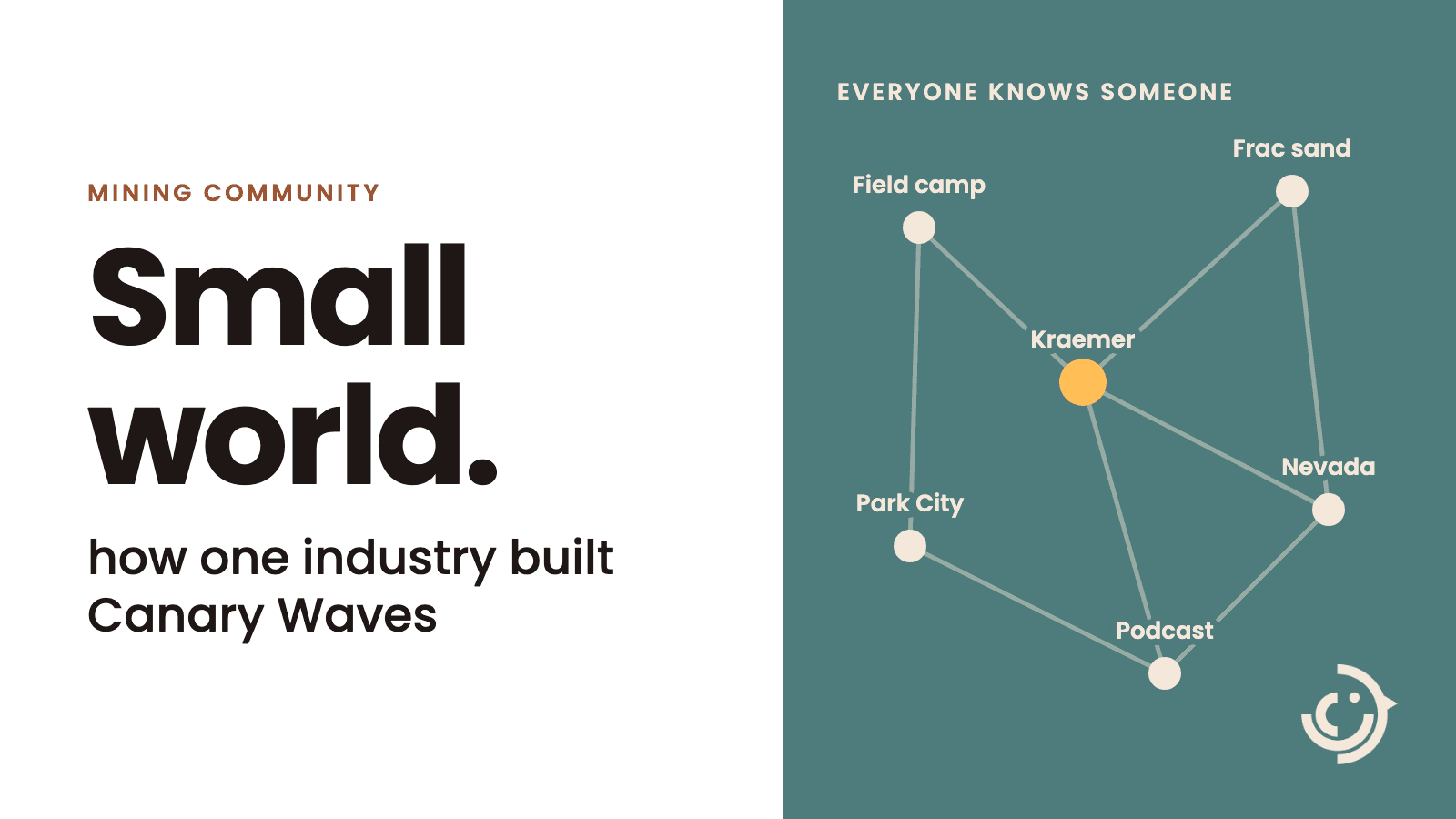
Partway through episode 53 of the Mine EX-Plorers podcast, the hosts realized something. They already knew Jack Kellner's co-founder. Julia Georgi had worked with them on aggregate pricing years earlier. They remembered her leaving "to go do something to do with two-way radio chatter," and had never put it together that it was the same company.
"It's a small world," one of them laughed. It is. And for anyone building something in this industry, that small world is not trivia. It is how the mining community actually works: through field camps, old colleagues, local history groups and a lot of trust earned slowly. Canary Waves is a product of exactly that.
A mining-history nonprofit made the introduction
Jack did not meet the podcast hosts through a conference or a cold message. They connected through Friends of Ski Mountain Mining History, a nonprofit in Park City, Utah. It preserves the old mining structures that still stand on the ski hills and around town, and has raised millions to stabilize them. That season it had finished work on the Silver King mill building: a new roof underneath, and the old rusty roof put back on top so it still looks like itself.
It is a good picture of the industry. People who spend their careers in operations, consulting and capital projects also volunteer to keep an old headframe standing. The shared history is part of the glue.
Field camp, frac sand and a lot of overlapping careers
Jack's own path into mining runs through the same kind of connections. A geology field camp in the American Southwest, taken as a second choice, hooked him on the subject. It is also where he met his wife, a geologist who now works for the Utah Geological Survey.
When the hosts and Jack compared notes, it turned out they had all lived through the same frac sand boom from different sides: hunting deposits across the western US, watching buyers swing from Northern White quality to "final mile" cost at the wellhead almost overnight. Ten minutes into the conversation, three people who had never worked together had a decade of shared reference points.
That is normal in mining. Careers move between operators, contractors, consultancies, regulators and suppliers, and people meet again. A site you worked at becomes a story you share. A colleague from one era becomes a partner in the next.
How an old colleague became a co-founder
That is literally how Canary Waves got its second founder. After a first co-founder fell through, Jack was left with a promising idea, a rough prototype and no software team. He called someone he trusted from his aggregates days at Kraemer Mining & Materials, where Julia had been implementing aggregate pricing tools at an operation moving around two million tons a year.
She was looking for something new. She sat in on a few calls, saw the problem first-hand, and joined. Her team, in Jack's words, "took it from GarageBand to a real product." We tell the full version in the Canary Waves founder story.
Neither of them had to explain the industry to the other. That shared context saved years.
Why relationships beat mandates at site level
The same lesson shapes how Canary Waves works with mines. Jack has seen, at the majors, how enthusiasm at head office can get "lost in translation" by the time a new tool reaches the site. Sometimes it arrives to outright resistance, because nobody built the relationship with the operation first.
So Canary Waves goes the other way. It starts with the people on site, finds champions inside the operation, and builds from the bottom up. The reasoning is simple. The operators are already solving the problems, and they are doing it over the radio. Any tool that ignores them, or adds work for them, will not last. We wrote about that pattern in Why Mine Safety Tools Die on the Frontline, and What Survives.
"Canary Waves is not going to solve your problem. Your operators are already solving the problem. We're just giving you the tool to listen to them."
A small industry is an advantage
For a young company, mining's size cuts both ways. Reputations travel fast, and a tool that wastes a site's time will be remembered. But trust travels fast too. A site champion who sees value tells a colleague at the next operation. A podcast host who already knows your co-founder vouches for her before you have said a word.
That is why Canary Waves invests in the community as much as the product: showing up on podcasts like Mine EX-Plorers, sharing what we learn on this blog and on LinkedIn, and, in Jack's case, posting the mining memes he jokes are becoming his claim to fame. If you have worked in this industry for a while, there is a good chance we already know someone in common.
For the technical and tailings side of the same episode, read KB&G's write-up: Mine EX-Plorers EP53: Waste From Mining to Intelligence.
See the signals we'd surface from a typical shift on your site. Book a 30-minute walkthrough.
FAQ
How did the Canary Waves co-founders meet?
Jack Kellner and Julia Georgi worked together at Kraemer Mining & Materials, an aggregates company, around 2017 and 2018, when Julia was implementing aggregate pricing software. Years later, after his first co-founder left, Jack reached out to her. She joined calls with mine sites, saw the problem and became co-founder.
Why does Canary Waves start with site teams instead of head office?
New tools often lose momentum between corporate enthusiasm and day-to-day site operations. Canary Waves builds relationships and champions at site level first, because operators are the ones already solving problems over the radio. Tools that ask nothing extra of them, and that they trust, are the ones that last.
What was Mine EX-Plorers episode 53 about?
In episode 53, Jack Kellner talked about tailings reprocessing at Regeneration, his path from geology into mining engineering, and the origin of Canary Waves: turning recorded two-way radio chatter into safety and operational insight before incidents happen, not after.