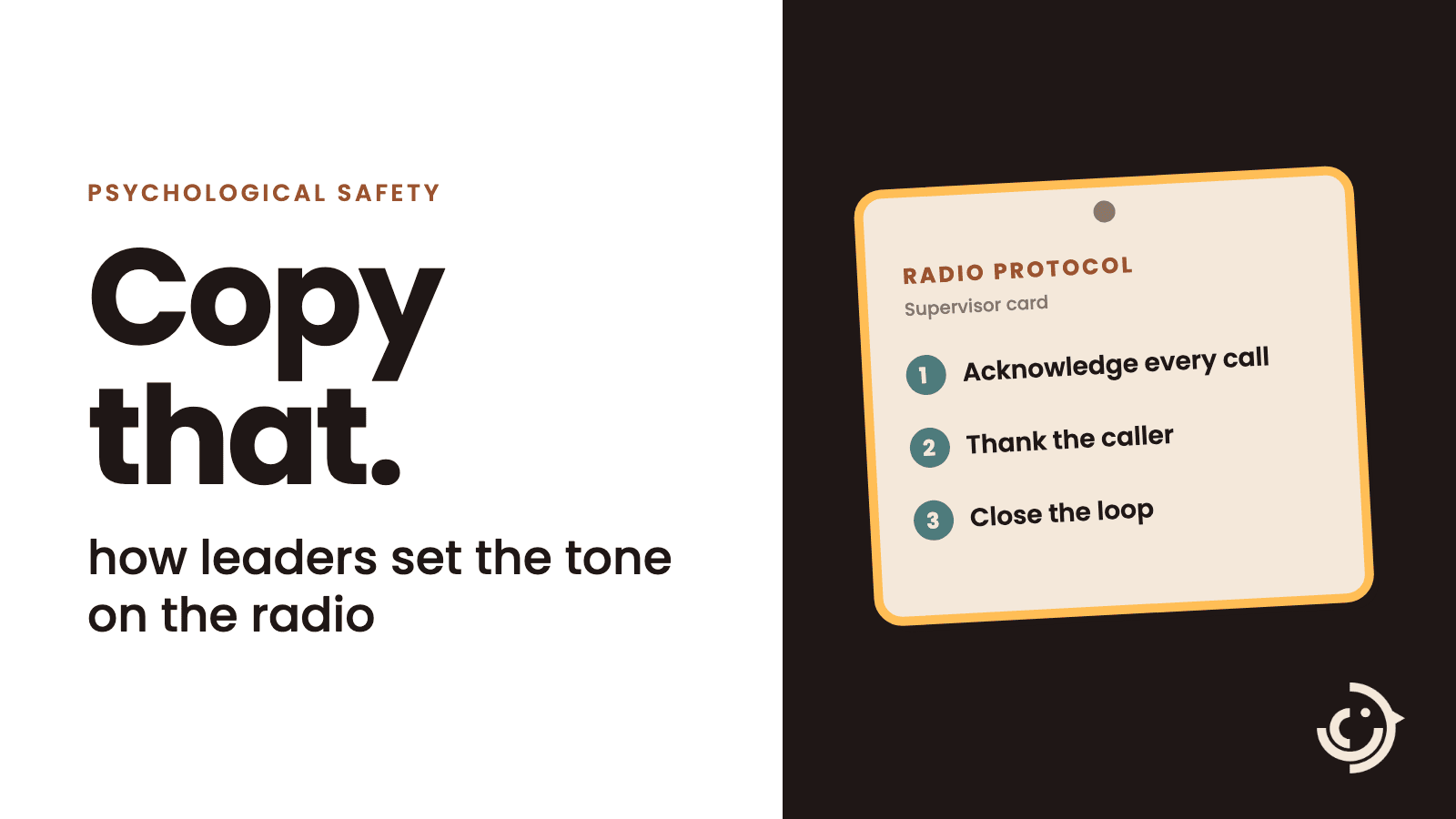
Near misses in mining don't land at random. In a 5-day analysis of radio traffic at one underground operation, March 1 to 5, near-miss warnings and sharp, aggressive exchanges clustered tightly around the peak congestion periods.
The radio doesn't just carry instructions. It carries stress. And stress, it turns out, is not random.
What one operation's radio said about stress and congestion
We looked at where near-miss warnings and sharp, aggressive exchanges showed up across each shift. They didn't scatter evenly. They clustered, tightly, around the peak congestion periods.
Those are the same periods when the haul roads were busiest. The same operation logged more than 365 "holding" calls in those 5 days, concentrated at the same declines and dump points every shift. We wrote about that bottleneck map in what 365 "holding" calls reveal about haul road congestion. When the queues built, so did the risk in people's voices.
That's not a coincidence to manage around. It's an early warning system the site already owns. When communication tone and near-miss language spike together, risk is rising at that location. That is worth knowing while the shift is still running, not in the debrief.
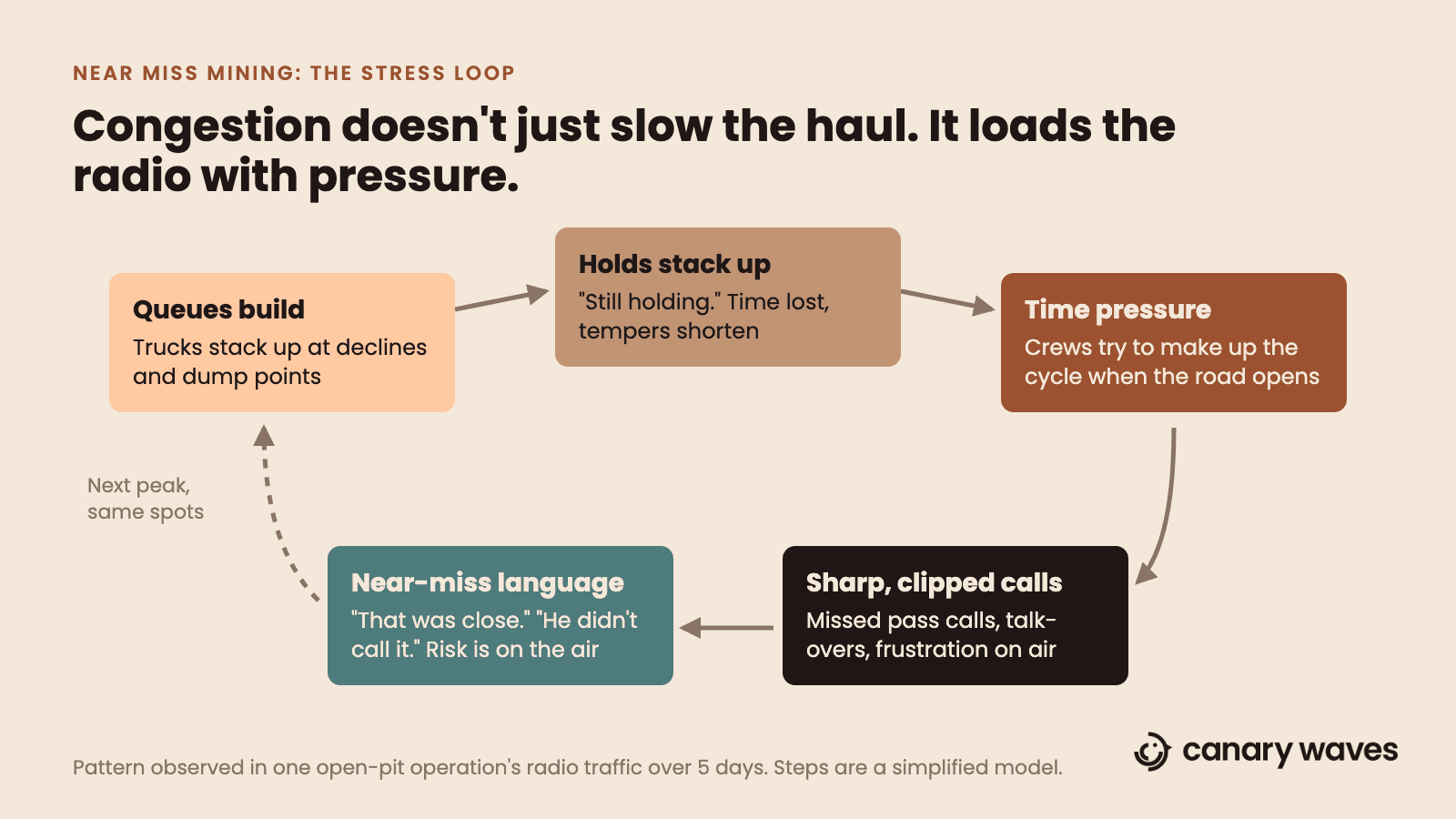
None of this blames the crews. An operator who has been held in a queue and is now behind on cycle time is responding to the pressure the system creates. The point is that the system is telling you about it, out loud, in real time.
Why near misses in mining deserve more of your attention
Mobile equipment is where mining's worst days still come from. In 2025, 13 of the 33 miners killed in US mines died in powered haulage accidents, according to MSHA. The Department of Labor has said that powered haulage and machinery have been the leading causes of serious and fatal mine accidents in recent years, which is why MSHA now requires written safety programs for surface mobile equipment.
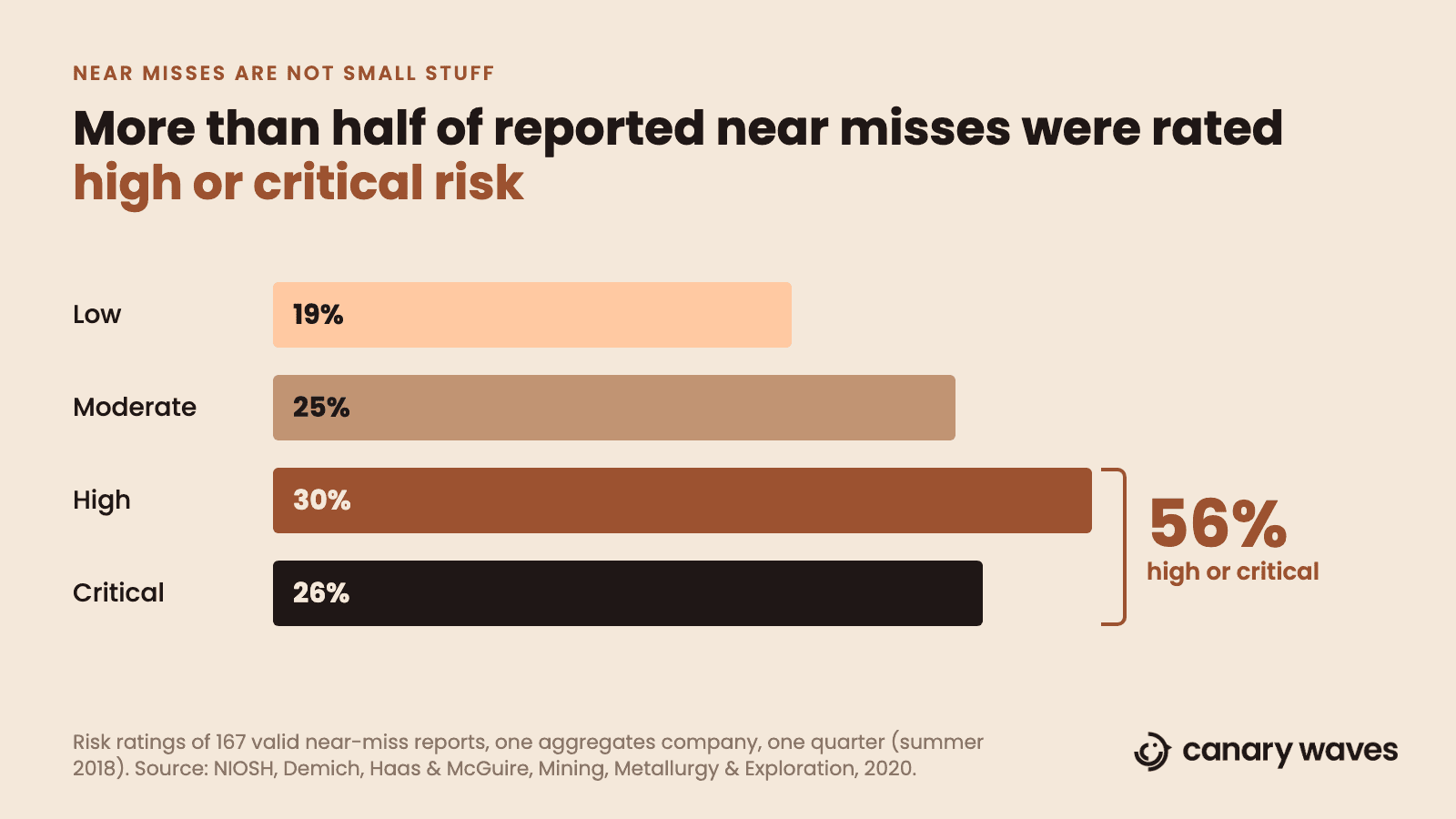
Near misses are the rehearsals for those days. A NIOSH case study of an aggregates company found that workers logged 249 near misses in a single summer quarter. Of the 167 valid reports, 30% were rated high risk and 26% critical risk. More than half of what got reported was serious. And that's only what got written down.
The link to stress isn't just a hunch from the haul road either. The Dutch National Institute for Public Health and the Environment (RIVM) has found that psychosocial workload is correlated with unsafe behavior, accidents and near misses, and workers it interviewed named time pressure as the factor with the biggest impact on safety. That research was in logistics, not mining.
Put those together and the picture is simple. The equipment that kills people is the equipment that queues. The queues create time pressure. Time pressure is linked to near misses. And a near miss that never makes it into a form leaves no record.
There's a reporting gap built into the shift itself. The moment a near miss is most vivid is the moment the operator has the least time to report it: still in the cab, still in the queue, still behind. A written near miss report captures what people remember and choose to write down hours later. The radio captures what they said when it happened, in their own words, with the location and the time attached.
Signals to listen for when near-miss risk is building
Crews don't describe psychosocial workload on the radio. The signals are plainer than that:
- Missed pass or intersection calls. One of the clearest near-miss markers on any haul road channel.
- Close calls mentioned on air, then dropped. A close call acknowledged on the channel that never turns into a report.
- Repeated holds at the same location. The second or third hold at the same spot in a shift, with replies getting shorter each time.
- Questions about routing or sequence. Uncertainty about where to go next, especially when a decline or dump point is backed up.
- Operators acknowledging they are being pushed. Pressure to move faster is a precursor to cut corners.
Any one of these on its own is just a busy shift. Several, clustered at the same location within the same hour, is a pattern. The supervisor who could act on that pattern may be somewhere else on site, on another channel, dealing with something else.
What good sites do about near-miss risk at peak congestion
You don't need new technology to start on this. These steps help.
- Know your peak windows. Congestion is often predictable: shift change, crib breaks, blast clearances, weather holds. Write them down and treat them as higher-risk periods, not just slower ones.
- Put a supervisor's ears where the queues are. During known peaks, have someone actively listening to the channels that cover the worst declines and dump points, with authority to slow things down.
- Take the clock off the queue. If operators are paid, ranked or nagged on cycle time, a long hold creates pressure to make it up later. Make it explicit that time lost in a queue is not time the operator owes back.
- Make close calls easy to report. A near-miss form that takes ten minutes to fill out will not get filled out after a twelve-hour shift. A one-line verbal report to the supervisor, logged by them, is better than nothing.
- Use the radio to reset the channel. A short, calm call from dispatch during a heavy queue, reminding crews to hold their spacing and that nobody is in trouble for the wait, takes the edge off. Tone is contagious in both directions.
- Review the radio, not just the forms. When something does happen, pull the recordings for the hour before. Listening only after an incident misses the build-up that came before it.
- Fix the bottleneck, not the people. If near misses keep clustering at the same decline, the long-term fix is a traffic, road or scheduling change. Toolbox talks help. Removing the queue helps more.
The last point matters most. Congestion that cooks the crews is often the same congestion cooking the fleet, which we covered in when congestion cooks the fleet. One fix can pay off twice.
Where Canary Waves fits
Canary Waves connects passively to the two-way radio a site already runs. It transcribes traffic, tuned to site slang and equipment names, and flags patterns like near-miss language, missed calls and repeated holds by location and time. Leaders get a shift-level summary that shows where pressure built and when, without operators changing a thing. You can see the kinds of signals we surface, or read how the same approach handles hazard identification in mining.
The crews are already saying it. Preventable should mean prevented.
See the signals we'd surface from a typical shift on your site. Book a 30-minute walkthrough.
FAQ
What counts as a near miss in mining?
A near miss in mining is an unplanned event that could have caused injury, damage or a fatality but didn't, often by seconds or meters. Common examples include missed pass or intersection calls, vehicles entering a blind spot, and loads or rocks falling near people or equipment.
Why do near misses increase during haul road congestion?
Congestion creates time pressure. Trucks sit in queues at declines and dump points, operators fall behind on cycle time, and when the road opens there's a push to catch up. That raises the odds of missed radio calls, rushed passes and shortcuts. Research on workplace stress links time pressure directly to unsafe behavior and near misses.
Can radio communication really predict near misses?
Radio traffic doesn't predict a specific event, but it shows when risk is rising. In one operation's 5-day radio analysis, near-miss warnings and sharp exchanges clustered tightly around peak congestion. When tone and near-miss language spike together at the same location, that's a leading indicator supervisors can act on during the shift.
Is radio analysis about checking up on individual operators?
It shouldn't be, and done properly it isn't. The goal is safety intelligence about the operation, not scoring individuals. Patterns are reported by location, shift and time, such as which decline generates the most near-miss language. The fix is usually a road, traffic or scheduling change, not a disciplinary one.
How should supervisors respond when near-miss language spikes on the radio?
Treat it as a live risk, not a behavior problem. Slow the traffic at the hotspot, confirm spacing and right-of-way calls, and have dispatch reset the channel calmly. After the shift, log where and when it happened. If the same decline or dump point keeps showing up, fix the road, traffic plan or schedule.