We get asked a version of this question a lot: if haul trucks are going driverless, won't mine radio become obsolete? It is a fair question for a company that listens to radio traffic for a living, and it deserves a better answer than an opinion. So our co-founder Jack Kellner, a mining engineer who has worked at Nevada Gold Mines and Rio Tinto, built a model to answer it with numbers.
Autonomous haulage mining is growing fast, from a small base
The growth is real, and worth taking seriously.
- GlobalData tracked 3,832 autonomous haul trucks on surface mines worldwide in July 2025, up 84% from 2,080 a year earlier, and expects the figure to reach close to 5,000 by the end of 2030. That count includes autonomous-ready trucks as well as those running autonomously (Mining Technology, August 2025).
- Komatsu announced in April 2026 that it had commissioned its 1,000th autonomous ultra-class haul truck, with FrontRunner customers having moved more than 11.5 billion metric tons of material (Komatsu).
- Meanwhile, the safety case for getting vehicle interactions right has not gone away. Powered haulage was the leading cause of US mining deaths in 2025, with 13 of 33 fatalities in MSHA's preliminary count (Pit & Quarry).
Thousands of trucks sounds like a lot. The question is: a lot compared with what?
We ran the numbers: Jack Kellner's fleet model
Jack's starting point was simple. Autonomy only replaces the radio if it replaces the people on the radio. So how much of the world's haul fleet is actually autonomous, and how fast can that change?
Here is what his model found:
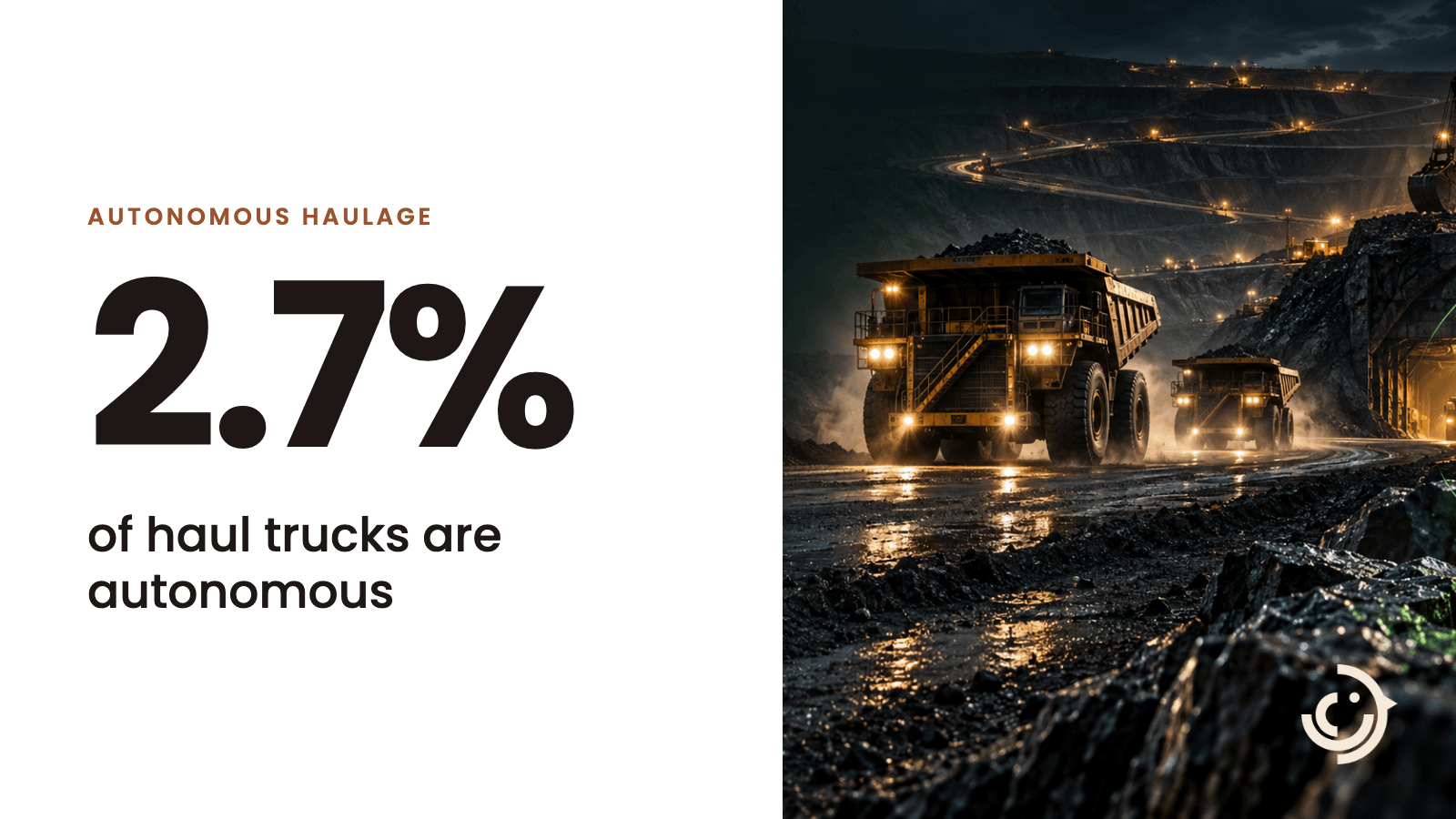
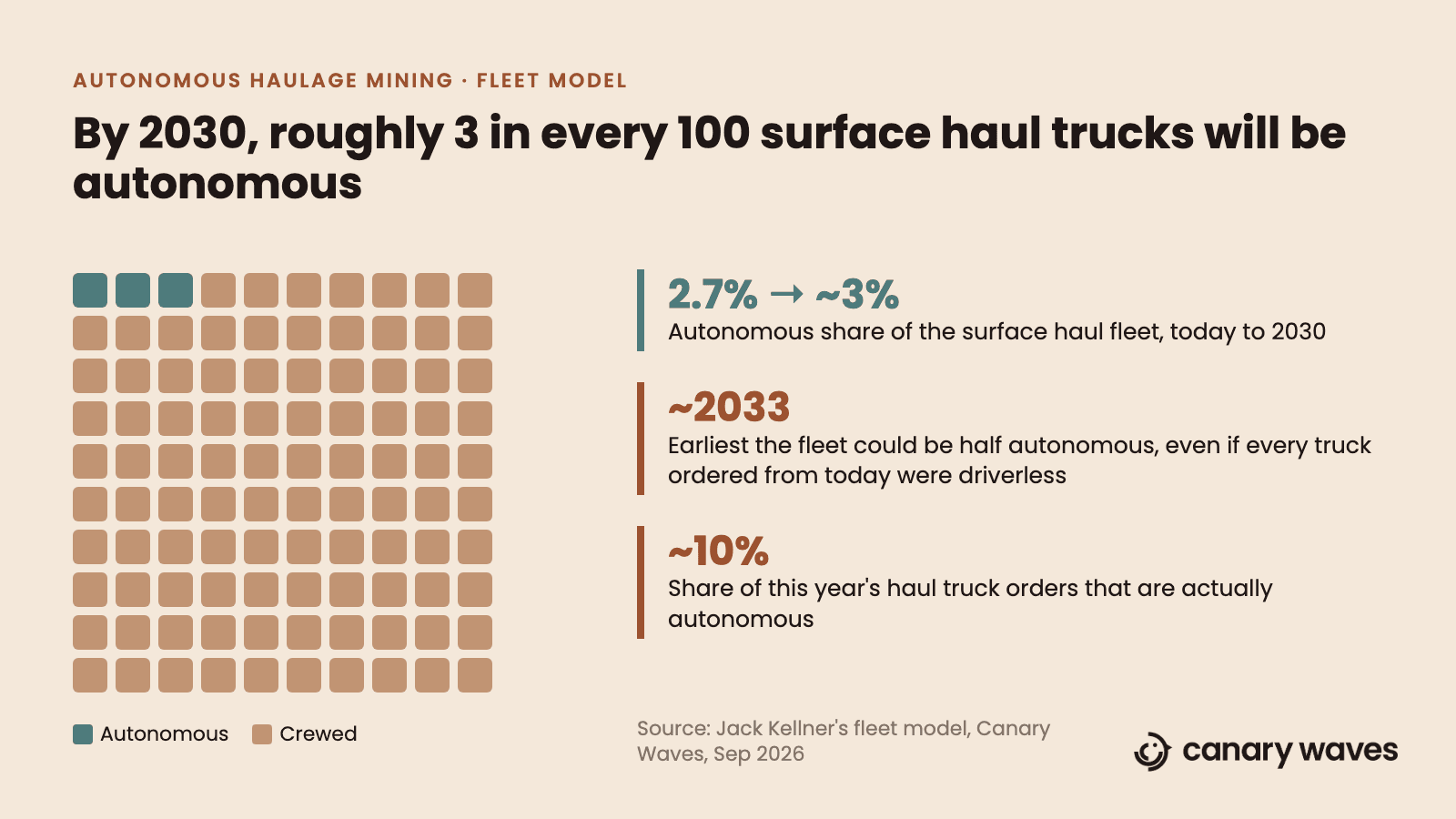
- Autonomous haul trucks are about 2.7% of today's surface mining fleet. On current trends, that rises to roughly 3% by 2030.
- Haul trucks last a long time. They run for 15 to 25 years or more, with rebuilds, so the global fleet turns over only a few percent a year. New technology arrives at the speed of replacement, not the speed of announcements.
- Even the most aggressive scenario is slow. If every haul truck ordered from today onward were autonomous, it would still take until about 2033 for half of the world's fleet to be driverless.
- Reality is far from that scenario. About 10% of this year's haul truck orders are autonomous. The other 90% will come with a cab, a seat and a radio, and they will be working for the next couple of decades.
Jack used AI tools to help gather data and check the model logic. The question, the assumptions and the conclusions are his, and they come from years of watching how fleets actually get bought, rebuilt and run. His bottom line: autonomous haulage will keep growing, and it will matter enormously at the sites that adopt it. But for most of the world's mines, for most of the next decade, haul trucks will still have an operator in the cab and a radio on the dash.
Mine fleets still run on the radio
If roughly 97 of every 100 haul trucks will still have an operator in 2030, the radio question mostly answers itself. Every one of those operators coordinates by voice: calls to dispatch, holds at the decline, breakdowns, route changes, hazards on the road. So do the graders, dozers, water carts, fuel and service trucks, light vehicles and contractors that keep a crewed operation moving.
That traffic is not going away on a timescale that matters to anyone running a mine today. And it carries early warnings. In our own analysis of five days of one underground operation's radio, crews called out more than 365 holds, 28 overheating reports and 37 hazards, all by voice.
Autonomous operations are a different setting. People are kept out of the active pit, and the trucks report through their fleet management system. That makes them a small and separate part of the picture, not a reason to stop listening to the rest of it.
Signals to listen for on a crewed fleet
On the 97% of the fleet that still has a driver, a few signals tell you where the friction is building:
- Repeated holds at the same spot. Shift after shift, it marks a bottleneck, not bad luck.
- Temperature complaints from the same unit. A maintenance warning that has not reached maintenance yet.
- Closures and detours called on air. A diversion dispatch is absorbing on the fly, with no record unless someone writes it down.
- Rock or debris reported on a road. A hazard that needs a fix, not just an acknowledgement.
- Long waits for a clearance. Delays between a request and a reply are where impatience, and shortcuts, creep in.
What good sites do while fleets change
None of this needs new technology to start.
- Standardize the key radio calls. Holds, clearances, breakdowns and hazard calls should each have one agreed call and one agreed reply, used by every crew and contractor.
- Brief contractors on the radio protocol, not just the site rules. New people may not know the channel plan or the closing call.
- Log holds, stops and hazard calls with time and place. A fleet system can record a stop without the conversation around it: who asked, why, and how long people waited.
- Review hot spots weekly. Look at where holds, diversions and hazard calls cluster. Those locations are candidates for road changes, extra capacity or different shift timing.
- Keep the people side in your safety program. MSHA's rule on written safety programs for surface mobile equipment asks operators to identify hazards with miner input. Much of that input is already on the radio.
And bring the crews along. As we wrote in why mine safety tools die on the frontline, the tools that last are the ones that ask the least of the people doing the work.
Where Canary Waves fits
Canary Waves listens to the human side of the fleet. It connects passively to your existing two-way radio, transcribes traffic tuned to site slang and equipment names, and shows leaders where problems pile up: holds, breakdowns, diversions, hazard calls and the stress that builds around them. It works with the radio your site already runs, with no new hardware and no change for operators. See the signals we surface, and how near-miss language spikes with congestion.
So, will autonomous haulage make mine radio obsolete? Not this decade. The operations pulling ahead aren't working harder. They're hearing more.
See the signals we'd surface from a typical shift on your site. Book a 30-minute walkthrough.
FAQ
What share of mining haul trucks are autonomous today?
According to a fleet model by Canary Waves co-founder Jack Kellner, autonomous haul trucks make up about 2.7% of today's surface mining fleet, rising to roughly 3% by 2030. GlobalData counted 3,832 autonomous or autonomous-ready haul trucks in July 2025, a fast-growing number that is still small next to the global fleet.
Will autonomous haulage replace two-way radio on mine sites?
Not soon. Haul trucks run 15 to 25 years or more, so fleets turn over slowly, and only about 10% of this year's truck orders are autonomous. For most mines over the next decade, the operators, support equipment and contractors who coordinate by radio will make up the large majority of the fleet.
How long until half the world's haul fleet is autonomous?
Jack Kellner's model shows that even if every haul truck ordered from today were autonomous, it would take until about 2033 for half the global fleet to be driverless. Since only around 10% of current orders are autonomous, the real timeline is much longer, and crewed trucks will make up most of the fleet for years.
Does Canary Waves still matter as mining fleets automate?
Yes. Autonomous trucks report through their fleet systems, but they are a small share of the global fleet and will be for years. The large majority of trucks, support equipment and contractors still coordinate by radio, and Canary Waves turns that traffic into shift-level summaries of holds, breakdowns, diversions and hazard calls.